Saturday, February 28, 2015

Ecosystem Services

                                                             Comments due by March 8, 2015
By Christian Neumann, Linwood Pendleton, Marianne Kettunen, Tundi Agardy

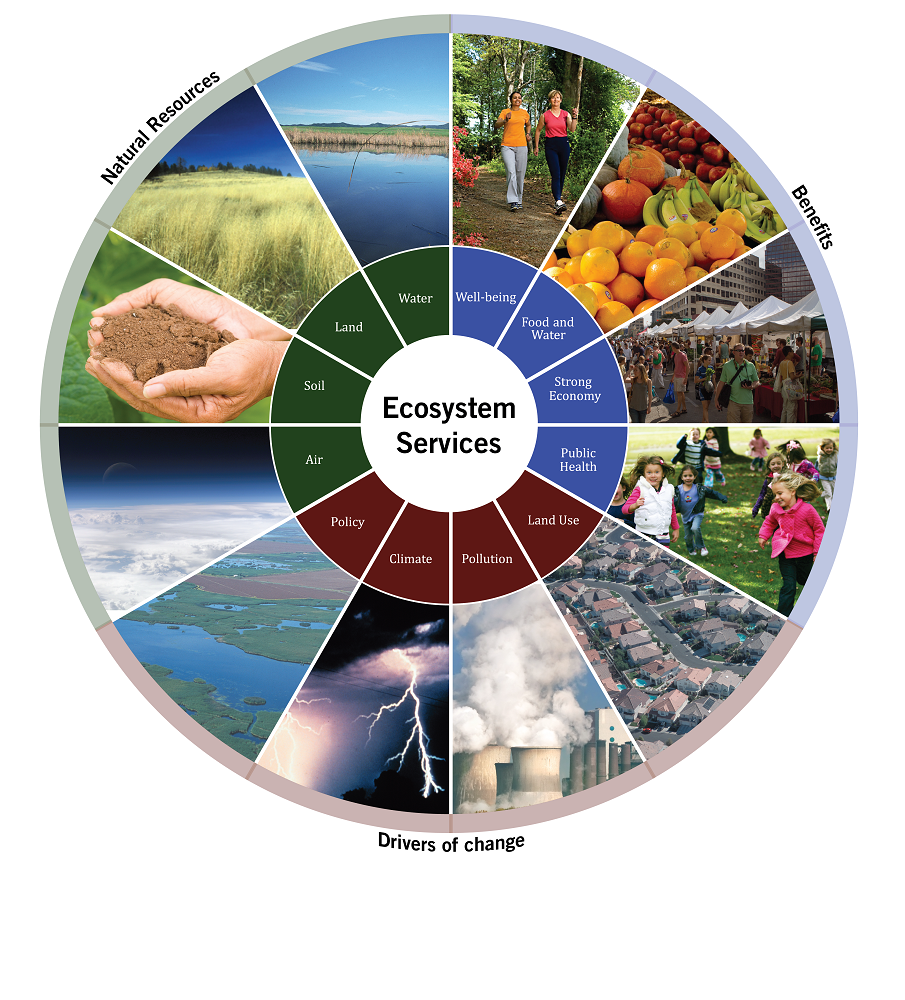
The value of ecosystems and the associated services they provide is receiving growing attention both in the public and decision-making arena. The language of Ecosystem Services essentially translates the complexity of ecological processes and functions into descriptors that define the socio-economic-ecological link. To overcome the challenge of scientific and non-scientific communities having to find a common language, it is worth keeping a few key aspects in mind.  

Talk about the big picture
The concept of Ecosystem Services has the potential to reconcile growth of the three pillars of sustainability (social, environmental and economic), often considered to be mutually exclusive: the concept recognises functional ecosystems as a foundation for social and economic development. At the same time, it helps us communicate the link between very direct human needs, such as healthy, clean drinking water, and rather indirect management responses such as securing the quality of upstream ecosystems that provide a water purification function.
The recent scientific advancement of the Ecosystem Services concept and its application in planning and decision-making have added substantial credibility to the understanding of the role that healthy, functioning ecosystems play for human well-being as well as social and economic development. Consequentially, Ecosystem Services have received growing attention from policy-makers as well as the public. However, this increased attention reveals the science to a broader, non-scientific audience, which is a challenge for both communities, as they often don’t speak a common language. 

Know whom you are talking with    
Within the scientific community it is important to maintain the scientific precision essential to advancing scientific understanding. However, in communication with the public, policy- or decision-makers or private sector representatives, it is important to recognise that while people might be familiar with the ecosystem services themselves, they are less so with the related concepts and its specific terminology. Communicating with non-scientific audiences in planning or other decision-making processes, for example through press articles or stakeholder consultation, language used by scientists should reflect the realities and understandings of the interactions of each audience with Ecosystem Services. 
Developing such situation-specific language should be a “co-creative” process, through bi-directional observation and listening. Such an effort will not only lead to a shared language, but in itself further add to the knowledge on local Ecosystem Services and their cultural, social and economic context. Working in a multi- and inter- disciplinarily manner with colleagues from natural, social and cultural sciences will help in both understanding and adapting the Ecosystem Service language to local contexts.
The more relevant Ecosystem Service information becomes for the public, the more careful the scientific community needs to become when balancing linguistic flexibility and scientific precision, in order to be able to convey messages clearly and correctly in layman terms, and to avoid terminology ‘wearing off’ (see for example the term ‘sustainable’).

Different kinds of values and metrics serve different audiences
Assessing the Total Economic Value (TEV) of Ecosystem Services, especially in monetary terms, has played an important role in bringing public attention to the value of nature’s non-market elements. TEV can continue to play such a role in relevant circumstances. In the context of more concrete planning and decision-making situations, however, particularly when informing trade-off decisions, focusing on marginal values of Ecosystem Service change rather than assessing the total values may better respond to audiences’ needs. 
Values and metrics other than economic ones can also be highly relevant to stakeholders and decision-makers, depending on local contexts and the objectives of the processes information is used in. These include, but are not limited to social values (for example safety, livelihoods, health or social cohesion) and cultural values (such as identity, artistic or spiritual values). 
Consequently, it is important to understand the target audience, their association with ecosystem services and their information needs when designing and implementing assessments and valuations. Messages should be thoughtfully crafted and communicated to convey the results of these assessments. 

Credibility matters
Ecosystem Services can be used to support arguments for specific, already existing objectives such as the conservation of a certain area, ecosystem or habitat. To avoid undermining scientific credibility, it is important to reveal such objectives when communicating about Ecosystem Services. Similarly, care should be taken to not ‘oversell’ claims about benefits associated with Ecosystem Services (for example coastal protection from extreme weather events), to avoid later disenchantment of stakeholders and policy- and decision-makers. Further, the usefulness of arguments for conservation based on Ecosystem Services might not work equally well in all circumstances (e.g. conservation of coastal vs. marine habitats). 
Ecosystem Services as a concept is necessarily a reduction of complexity – a fine balance needs to be struck to communicate complexity without losing relevance and tangibility. 

The language of Ecosystem Services creates new connections
When carefully applied in a relatable manner, the concept of Ecosystem Services has the power to bring together decision-makers and scientists from different disciplines. In turn, the resulting exchanges serve to further support the concept itself, as relationships are built and mutual understanding is developed. 
By connecting people and ecosystems, the concept of Ecosystem Services can support the reconcilement of environmental protection and sustainable use with social and economic development – if we speak a language everyone can understand.

Saturday, February 21, 2015

Decommissoning Rigs in the North Sea


                                                   Comments due by Feb. 28, 2015

 By STANLEY REED LONDON — Cleaning up an oil field in a forbidding environment like the North Sea may be almost as formidable a task as developing one, and in the coming years, those waters are likely to serve as a laboratory for what happens when the useful lives of oil fields expire. Royal Dutch Shell is beginning to decommission and dismantle its installations in the Brent field, which has produced nearly 10 percent of all the oil and gas extracted from British waters and gave its name to the most important globally traded blend of crude. Twenty years ago, Brent, which lies under more than 400 feet of water between the Shetland Islands, off Scotland, and Norway, was the scene of a landmark battle between the environmental movement and the oil industry over a relatively minor dismantling job. Greenpeace, the activist group, succeeded in deterring Royal Dutch Shell from disposing of a mammoth storage buoy called the Brent Spar in the depths of the ocean through stunts like landing a protester on the installation with a helicopter.Now, after nearly 40 years of production that yielded about 30 billion pounds, or about $46 billion, in revenue, two­ thirds of it going to taxes, Shell has filed proposals to start taking apart one of the field’s four platforms, called the Brent Delta. “One wonders if future generations will see this as one of the events marking the beginning of the end of the fossil fuel era,” said Anthony Hobley, chief executive of Carbon­Tracker, a London­based organization that advises investors on the risk of fossil fuel investments. Shell estimates that cleaning up the whole field, which has four platforms, will require a decade and cost billions of pounds. Certainly the process will be closely watched, not least because Brent will be the largest North Sea field to be decommissioned so far. With many of the sea’s fields in decline and running at meager profit levels, or even losses, after the recent sharp fall in oil prices, other operators are facing the same gargantuan task now confronting Shell. The decommissioning will mark the beginning of an expensive sunset phase. “No one quite knows the full extent of the cost of decommissioning,” said Malcolm Dickson, an analyst at Wood Mackenzie, an industry consulting firm based in Edinburgh. Estimates of the costs keep going up year after year because “companies have not grasped the extent that could be involved,” he said. Wood Mackenzie forecasts that the oil industry will spend £15 billion over the next decade on decommissioning in Britain, and that by the early 2020s, annual costs for dismantling fields may exceed new investment. As recently as 2013, the industry spent about £900 million on decommissioning while investing more than £14 billion in British waters. The sheer scale of the task that Shell is facing on Brent gives an inkling of the complexity and potential risks. Earlier this month, Shell filed plans with the British government to remove the portion of the Brent Delta platform that includes the housing for crew members and heavy­duty work areas. A giant, specially built ship will lift off this top section, a structure that weighs 23,500 tons, and carry it to shore to be cut into pieces and largely recycled. Shell also plans to take apart two other Brent platforms called Alpha and Bravo, which ceased production at the end of last year. Production at the Delta platform, which is more than 100 miles from shore, ceased in 2011, and workers have already begun to dismantle it. What’s likely to be particularly expensive and difficult to assess beforehand is dealing with the massive support pillars, pipelines and other apparatus that are underwater. The North Sea is like a spaghetti bowl whose rim is laced with pipelines and other equipment. Brent, for instance, has 28 pipelines and 140 wells that will need to have their well heads and other equipment removed before being plugged. Each platform is anchored to a concrete base that weighs almost as much as the Empire State Building in Manhattan, according to Shell. “Everyone thinks about the topsides and what is visible above the waves,” said Duncan Manning, Shell’s business opportunity manager for the Brent project, “but what actually takes the time is plugging and making safe the wells.” Because of the costs and the unknowns, operators try to keep oil fields going even if they are running at a loss. In the 1990s, Shell and co­owner Exxon Mobil spent big money refashioning Brent, which had been a key oil producer, into a natural gas field. Mr. Manning said that before deciding on decommissioning Brent, the company also considered other possible uses for its structures there, like wind farms or the emission reduction technique known as carbon capture and storage. Other operators seem likely to face similar problems. Over the next decade, for instance, more than 900 wells in British waters, nearly 20 percent of the total, are expected to be taken offline at a total cost of £6.4 billion, or about £7 million per well, according to Oil & Gas UK, an industry group. The organization estimates that decommissioning will cost nearly £40 billion through 2040. A large part of the cost will probably be funded by the British taxpayer. Greenpeace may take a certain satisfaction in the plans that have been revealed by Shell, which is based in The Hague. The company is following a treaty called the Oslo/Paris Convention that was signed by northern European countries in the years after the Brent Spar fight. “Shell has agreed to take onshore the topside, which is actually just complying with international law,” said Doug Parr, policy director for Greenpeace UK. Shell says it is applying the lessons taught by the Brent Spar episode. “We did not consult widely enough when we decommissioned the spar 20 years ago,” Mr. Manning said. This time, he said, Shell has spent eight years consulting a wide range of groups, and its proposals reflect their input. Shell wants to leave large pieces of equipment on the sea bottom. The company acknowledges that a half­century ago, when Brent was developed, “decommissioning did not feature highly in the design considerations.” Mr. Parr conceded that it may make more sense to leave giant pieces of concrete in place than further disturb the environment by moving them. Mr. Parr said his group was waiting to see what Shell actually does. “Engaging with us is different from taking notice,” he said. “Let’s see how things develop on that front.”

Friday, February 13, 2015

Plastic In the Ocean

                                              Comments due by Feb. 21, 2015
Marine scientists have long known that plastic pollution in the ocean is a huge problem. The most visible sign of it is the Great Pacific Garbage Patch, an accumulation of waste (actually spanning several distinct patches) floating in the ocean. It’s at least twice the size of Texas and can be seen from space. This pollution has an incalculably lethal effect on everything from plankton to whales.
So just how much plastic is there? A new study in Science yesterday put out some pretty horrifying numbers: In 2010, the study finds, between 4.8 and 12.7 million metric tons (that’s about 10.5 billion to 28 billion pounds) of plastic entered the oceans — the median of those estimates is 1.3 times the weight of the Great Pyramid at Giza.
If we want to crack down on all that plastic, knowing where it all comes from could be as important as knowing how much there is. That’s the main idea behind this study. A team of scientists led by University of Georgia environmental engineer Jenna Jambeck set out to calculate how much plastic every one of the world’s 192 coastal countries dumps into the ocean. To do it, they combined data on each country’s per-capita waste generation, the size of the population living within 50 kilometers of the ocean, the percentage of waste that is plastic, and the percentage of plastic waste that is “mismanaged” (defined as “either littered or inadequately disposed”).
The last step is to estimate how much of the mismanaged coastal plastic waste actually washes into the sea. (This is the step that explains the wide uncertainty range in the grand totals above.) Jambeck drew on existing literature on waste streams from places like South Africa and the Bay Area to reach an estimate of 15-40 percent; she then applied that range across the board.
The chart below shows the worst offenders, in terms of total plastic pollution in the ocean in 2010, using data from the study. The top-ranks belong to middle-income countries with rapidly growing coastal populations that lack the resources to keep pace with waste management infrastructure. By contrast, even though the United States has relatively good waste management, its per-capita waste production is so high that it makes the top 20.
plastic-ranking_1
Tim McDonnell
That’s right: China alone dumped nearly 5 billion pounds of plastic waste into the ocean in 2010. But what’s even worse is just how much the study projects these numbers will grow in the future, based on predictions of population growth in each country by 2025. The chart below shows the top-ranked countries in terms of total mismanaged plastic waste (in other words, not all of this plastic is necessarily winding up in the ocean). China is still very much in the lead, and India shows a disturbing explosion of plastic pollution:
ocean-plastic-chart-2
Tim McDonnell


Friday, February 06, 2015

BP & Shell will consider the cost of climate change.

                                    Comments due by Feb. 14, 2015
BP will support a shareholder resolution calling on the company to release information about how climate change could affect its business. It’s the second big win for climate-conscious investors this year: Shell agreed to support a similar resolution last week.
Both the Shell and BP resolutions were submitted by a coalition of activist investor groups representing more than 150 major shareholders in Europe and America, including the U.K.’s Environment Agency and the Church of England, for a combined $300 billion in assets.
The resolution asked Shell and BP to reduce emissions, to invest in renewables, to provide transparency about bonuses that reward “climate-harming activities,” and to test how their business models would hold up if governments were to take action to limit global warming to 2 degrees Celsius. These steps are good business, the resolution argues, “given the recognised risks and opportunities associated with climate change.”
Analyses suggest that in order to stay below the 2 degree level, much of the fossil fuel in the ground will have to stay there — including all of the oil remaining in the Arctic, which both Shell and BP are hoping to tap. If governments take more stringent action to confront climate change, these resources could end up stranded, despite the high value oil companies place on them. That’s led some, like U.N. climate chief Christiana Figueres, to suggest that investors in extractive industries should worry about a “carbon bubble.”
“Climate change is a major business risk,” said James Thornton, CEO of ClientEarth, one of the investor groups behind the push, when the resolutions were filed last month. “BP and Shell hold our financial and environmental future in their hands. They must do more to face the risks of climate change. Investors can help them by voting for these shareholder resolutions.”
JJ Traynor, Shell’s executive vice president of investor relations, sent a letter on Jan. 29 to shareholders in the company urging them to support the resolution. And yesterday, Reuters reported that a spokesperson for BP said his company would also support the resolution. “We consider the resolution to be non-confrontational, and it gives us the opportunity to demonstrate our current actions and build on our existing disclosures in this area,” the spokesperson said in an email.
Elspeth Owens, a representative of ClientEarth, called BP’s decision “great news” and said that the victory “confirms the potential of shareholder engagement.”
Both oil companies rank among the largest, by revenue, in the world. Investor activists withdrew a similar resolution filed with ExxonMobil last year after the company agreed to publish publicly a report on how future regulations, like carbon pricing, could affect its bottom line. (If you’re curious, ExxonMobil more or less said regulations won’t affect that bottom line much at all, really, because regulations aren’t actually coming. Ben Adler summarized the company’s position thusly: “Governments will allow us to keep extracting and burning fossil fuels because the economy.”)
As for BP and Shell, both resolutions still have to be voted on by their shareholders. BP will recommend that its investors support the resolution at a meeting on April 16. Shell, meanwhile, is encouraging shareholders to vote for the resolution at its annual general meeting in May.

Saturday, January 31, 2015

The Rise and Fall of Ecological Economics

                                              Comments due by February 7, 2015
The following is a summary of a much longer article by Mark Sagoff.
The early 1980s were a period of crisis and change for the environmental movement. President Ronald Reagan had swept to power by campaigning against "environmental extremists" who he said favored "rabbits' holes" and "birds' nests" over jobs and economic growth. In office, Reagan filled his cabinet with anti-environmentalists and subjected environmental regulations to cost-benefit tests.

Greens were challenged intellectually as well as politically. In 1981, a 48 year-old Indian economist named Amartya Sen published a ground-breaking book showing that famines occur not because of failures of production but failures of distribution due to things like poverty, war, and political oppression. Sen's work, for which he eventually won the Nobel Prize, combined with the fact that per capita food consumption rose through the 1970s, discredited the Malthusianism that had been promoted by prominent ecologists such as Stanford University's Paul Ehrlich.

A new scientific case for environmental action was needed, and a new discipline -- ecological economics -- emerged to fill the role. Over the next 30 years, the concepts of ecological collapse, tipping points, and putting a price on nature would fleck the discourse of global political elites in the halls of McKinsey, Davos, and the U.N. Popular figures such as Thomas Friedman, Al Gore, Amory Lovins, Paul Hawken, and Bill McKibben would draw on concepts developed by the ecological economists Herman Daly and Robert Costanza to claim that economic growth undermines the planet's capacity to support human civilization.

In a sweeping new history of the era written for the Breakthrough Journal, the esteemed environmental philosopher Mark Sagoff writes:


Ecological economists distinguished themselves from neo-Malthusian catastrophists by switching the emphasis from resources to systems. The concern was no longer centered on running out of food, minerals, or energy. Instead, ecological economists drew attention to what they identified as ecological thresholds. The problem lay in overloading systems and causing them to collapse.


But outside the limelight, working ecologists were rejecting the idea of nature as closed, rule-bound "systems" existing in varying states of equilibria. "There is no dynamic order, force, or principle of self-organization that makes every hodgepodge a system," writes Sagoff. Species come and go, and the "systems," "progressions," and "equilibria" are mental constructs. Empirically-oriented ecologists returned to the work of scientists like Henry Gleason who in 1917 described "each association of plants and animals as unique, ephemeral, spontaneous, idiosyncratic, extemporaneous, and a law unto itself."

The radical ambitions of ecological economists to subject the economy to the laws of nature diminished greatly. Many joined the prosaic efforts of neoclassical economists to price ecosystem services; Costanza put the total value of the earth's ecosystems at $33 trillion.

"The Rise and Fall of Ecological Economics" is a cautionary tale. "If environmental decisions are fundamentally framed as questions of economic welfare," Sagoff concludes, "public officials and the public itself will opt nearly every time for whatever policy promises more economic growth, more production, and more jobs." In their obsession to model and monetize nature, ecologists and environmentalists lost their way. Says Sagoff, a former Pew Scholar in Conservation and the Environment:
The scientistic and self-referential controversies in which ecological economists engage drain away the moral power that once sustained environmentalism. This moral power may return if environmentalists employ science not to prescribe goals to society but to help society to achieve goals it already has.

Saturday, April 26, 2014

Are the IPCC Recommendations Inefficient?

By Samantha Olson on April 25, 2014 8:27 PM EDT
Economists Believe Climate Change Isn't Treated Efficiently
After reevaluating the global approach to climate change, economists estimate an inefficient plan to decrease future costs. (Photo: report was released by the Intergovernmental Panel on Climate Change (IPCC), is the international body of experts who are organized to evaluate the science related to climate change.


The IPCC's report estimates lower costs of climate change and higher costs of decline, which ultimately means that these efforts should work. However, when the estimates are adjusted for how people will act in reality, economists believe that this is not the case.

The real-world climate policy does not demand an ideal and uniform price for carbon, which according to economists means that the costs of emission reduction will be much higher than the IPCC's estimates.

If we carry heavier costs now than the benefits those costs will provide in the future then that is making us poorer now than we need be. And if we're not willing to bear the costs now that are smaller than the benefits in the future then that makes the future poorer than it need be. This is, absolutely, the standard analysis of this problem, this is the mainstream scientific consensus on this point.

If countries, especially wealthier countries who have more power to change the effect on climate because of emissions and finances, bear more of the burden of cost now than the benefits those costs will provide in the future, there is economic inefficiency.

Current United Nations negotiations focus on stabilizing atmospheric concentrations of greenhouse gases at lower levels than recommended. Economists disagree with lower levels because they are found to be unrealistic and generate feelings of failure when they aren't reached.

"The UN targets are probably never optimal. Using a utility discount rate that is more in line with those observed in public or private investment leads to substantially less stringent climate policy," says Richard S J Tol, co-lead author and professor or Economics, University of Sussex; and professor of the Economics of Climate Change, Vrije Universiteit Amsterdam.

Economists have coined the term "rational expectation" to define when reality is taken into consideration and a plan of action needs to be evaluated. In the case of climate change, the UN's target is too demanding because people don't take the possible severity of future consequences appropriately into account.
Putting aside all discrepancy to whether or not climate change is actually a global phenomenon, many economists view the environment's status as a functioning business.

"Climate change is a result of the greatest market failure the world has seen," Sir Nicholas Stern professor of Economics and Government at the London School of Economics.

Instead of agreeing on what temperature level or level of emissions should be limited, the amount of costs we're willing to afford are regulated. The future temperature consequences rise in an inefficient manner because financial cost is used as the constraint. Economists predict the ramifications will include undeterminable temperature rises.

"The combustion of fossil fuels is most probably the main cause of global warming, which is likely to induce substantial costs on the global economy. There is considerable uncertainty about the strength of these effects, as well as regarding their geographic distribution," says John Hassler, professor of Economics at the Institute for International Economic Studies.

Sunday, April 13, 2014

Open Access/ Tragedy of Commons/Personal Freedom/Coase...


Photos: Showdown in Nevada A 20-year dispute between a Nevada rancher and federal rangers over illegal cattle grazing erupted into an Old West-style showdown on the open range this week, even prompting self-proclaimed members of militia groups from across the country to join the rancher in fighting what they say is U.S. "tyranny."

What began as a legal fight between longtime rancher Cliven Bundy and the U.S. Bureau of Land Management has escalated as Bundy kept his cattle on the federal land, and the government has responded by beginning roundups of the livestock.

A confrontation teetered on violence Wednesday when Bundy family members and dozens of supporters angrily confronted a group of rangers holding Tasers and barking dogs on leashes near Bunkerville, about 80 miles northeast of Las Vegas.

Federal officials say a police dog was kicked and officers were assaulted.
Photos: Showdown in Nevada

Bundy family members say they were thrown to the ground or jolted with a Taser.
In the end, the rangers got into their white SUVs and drove away, a YouTube video of the incident showed.
"Get out of our state!" the cheering protesters yelled at the rangers as they departed in several vehicles. "BLM go away! BLM go away!" they added, referring to the Bureau of Land Management.

The entire incident is now under investigation, Amy Lueders, the bureau's director in Nevada, said Thursday.
To some, the 67-year-old Bundy is a hero who hails from a long family of ranchers stretching back to the Wild West.

To environmentalists and the feds, however, he's an outlaw of sorts who owes U.S. taxpayers more than $1 million in unpaid grazing fees.

The U.S. government is rounding up Bundy's cattle that it says have been grazing illegally on public lands in Clark County for more than 20 years, according to the land-management bureau and the National Park Service.

Between Saturday and Wednesday, contracted wranglers impounded a total of 352 cattle, federal officials said. Bundy says he owns 500 of the more than 900 cattle that federal officials are planning to confiscate for illegal grazing, the Las Vegas Review-Journal reported. Bundy told the newspaper that each head of his livestock is worth about $1,000.

Since the roundups began, protesters have been confined to two areas to publicly declare their grievances, but the peaceful protests in recent days "have crossed into illegal activity, including blocking vehicles associated with the (roundup), impeding cattle movement, and making direct and overt threats to government employees," the two federal agencies said in a statement.

On Wednesday, a bureau truck driven by a civilian employee assisting in the roundup "was struck by a protester on an ATV and the truck's exit from the area was blocked by a group of individuals who gathered around the vehicle," the agencies' statement said.

In the scuffle with protesters, a police dog was kicked, and officers protecting the civilian driver were threatened and assaulted, the two agencies' statement said. "After multiple requests and ample verbal warnings, law enforcement officers deployed Tasers on a protestor," the statement said.

The profanity-laced tussle was captured on a video posted on YouTube. A group that said it posted the video didn't respond to requests for comment.

In the video, protesters demanded to know why a backhoe and a dump truck were being used in the roundup -- and whether any livestock were killed. On Thursday, Lueders said the heavy equipment was used for field restoration.

"No BLM! No BLM!" the protesters chanted to rangers in the middle of a two-lane rural highway.

What sounds likes zapping Tasers can be heard in the video.

In the wake of the publicized protests, members of various militia groups have been traveling from Virginia, Texas, Montana, Idaho and Wisconsin and arriving at the protest site and Bundy's ranch to support the family, said Stephen L. Dean, 45, of Utah, a member of one such group called the Peoples United Mobile Armed Services.

"It's tyranny in government," Dean said when asked what brought him to Nevada.
And, he added, "stealing people's cattle."

One banner at the protest side stated: "Has the West been won? Or has the fight just begun!"
In removing Bundy's livestock from public lands, the park service and land bureau are carrying out two U.S. District Court orders from two different judges.

"Cattle have been grazing in trespass on public lands in Southern Nevada for more than two decades," the National Park Service said. "The BLM and NPS have made repeated attempts to resolve this matter administratively and judicially. Impoundment of cattle illegally grazing on public lands is an option of last resort."

Added the BLM: "Mr. Bundy has also failed to comply with multiple court orders to remove his cattle from the federal lands and to end the illegal trespass."

The bureau does allow grazing on federal lands -- it administers 18,000 grazing permits and leases on 157 million acres across the country, the agency said.

Bundy's dispute with the government began about 1993 when the bureau changed grazing rules for the 600,000-acre Gold Butte area to protect an endangered desert tortoise, KLAS reported.
Bundy refused to abide by the changes and stopped paying his grazing fees to the federal bureau, which he contends is infringing on state rights. His family has been ranching since the 1800s, before the U.S. Department of Interior was created and endangered species became a federal issue, he said in an interview with KLAS.

"My forefathers have been up and down the Virgin Valley ever since 1877. All these rights I claim have been created through pre-emptive rights and beneficial use of the forage and the water. I have been here longer. My rights are before the BLM even existed," Bundy told the station.

"With all these rangers and all this force that is out here, they are only after one man right now. They are after Cliven Bundy. Whether they want to incarcerate me or whether they want to shoot me in the back, they are after me. But that is not all that is at stake here. Your liberty and freedom is at stake," he continued.
And Bundy sees it as a state issue.

"The federal government has seized Nevada's sovereignty ... they have seized Nevada's laws and our public land. We have no access to our public land and that is only a little bit of it," he said.

This week, Nevada Gov. Brian Sandoval told the bureau of residents' criticism of the roundup.

What Sandoval said he found "most disturbing" was the BLM's use of a "First Amendment area" that confined protesters to a designated area.

Such an area "tramples upon Nevadans' fundamental rights under the U.S. Constitution," Sandoval said. "No cow justifies the atmosphere of intimidation which currently exists nor the limitation of constitutional rights that are sacred to all Nevadans."
 
In response, federal officials are allowing the protesters to gather on public lands as long as they don't impede the roundup, said Lueders, the BLM's director in Nevada.

Bundy is digging in for a long fight.

"I've been fighting this for a number of years. It's not about my cows, I'll tell you that much," he said at a town meeting on Wednesday night. "It's about freedom and liberty and our Constitution ... and above all it's about our policing power. Who has policing power today?"

With the growing controversy, it was uncertain Thursday how long the cattle roundup will now last. At Wednesday night's meeting, residents gave Bundy a standing ovation when he publicly spoke.

"I love you people. And I love this land, and I love freedom and liberty," Bundy told the crowd. "I know without doubt that our Constitution didn't provide for anything like the federal government owning this land, and so when I pay my grazing fees -- if I owe any grazing fees -- I will sure pay it to the right landlord, and that will be to Clark County, Nevada."

Sunday, April 06, 2014

IPCC sounds the alarm again. Is anyone listening?


The Intergovernmental Panel on Climate Change has released its latest report on the impacts of global warming, projected changes under various scenarios for greenhouse gas emissions and options for limiting related risks. Justin Gillis, reporting from the meeting in Yokohama, Japan, where government officials from around the world signed off on the summary document over the weekend, has summarized the prime conclusions and statements of panel leaders.
You can watch video of officials’ and authors’ comments here.
Here are the main bullet points from the summary on impacts of the changing climate that have already been detected (it’s important to note that the panel stresses it is not, in this section, assessing how much of the change is human-driven or the result of natural variability):
In recent decades, changes in climate have caused impacts on natural and human systems on all continents and across the oceans. Evidence of climate-change impacts is strongest and most comprehensive for natural systems. Some impacts on human systems have also been attributed to climate change, with a major or minor contribution of climate change distinguishable from other influences.
In many regions, changing precipitation or melting snow and ice are altering hydrological systems, affecting water resources in terms of quantity and quality (medium confidence). Glaciers continue to shrink almost worldwide due to climate change (high confidence), affecting runoff and water resources downstream (medium confidence). Climate change is causing permafrost warming and thawing in high-latitude regions and in high-elevation regions (high confidence).
Many terrestrial, freshwater, and marine species have shifted their geographic ranges, seasonal activities, migration patterns, abundances, and species interactions in response to ongoing climate change (high confidence)…. While only a few recent species extinctions have been attributed as yet to climate change (high confidence), natural global climate change at rates slower than current anthropogenic climate change caused significant ecosystem shifts and species extinctions during the past millions of years (high confidence).
Based on many studies covering a wide range of regions and crops, negative impacts of climate change on crop yields have been more common than positive impacts (high confidence). The smaller number of studies showing positive impacts relate mainly to highlatitude regions, though it is not yet clear whether the balance of impacts has been negative or positive in these regions (high confidence). Climate change has negatively affected wheat and maize yields for many regions and in the global aggregate (medium confidence). Effects on rice and soybean yield have been smaller in major production regions and globally, with a median change of zero across all available data, which are fewer for soy compared to the other crops….
Observed impacts relate mainly to production aspects of food security rather than access or other components of food security…. Since AR4, several periods of rapid food and cereal price increases following climate extremes in key producing regions indicate a sensitivity of current markets to climate extremes among other factors (medium confidence).
At present the worldwide burden of human ill-health from climate change is relatively small compared with effects of other stressors and is not well quantified. However, there has been increased heat-related mortality and decreased cold-related mortality in some regions as a result of warming (medium confidence). Local changes in temperature and rainfall have altered the distribution of some water-borne illnesses and disease vectors (medium confidence). Differences in vulnerability and exposure arise from non-climatic factors and from multidimensional inequalities often produced by uneven development processes (very high confidence). These differences shape differential risks from climate change…. People who are socially, economically, culturally, politically, institutionally, or otherwise marginalized are especially vulnerable to climate change and also to some adaptation and mitigation responses (medium evidence, high agreement). This heightened vulnerability is rarely due to a single cause. Rather, it is the product of intersecting social processes that result in inequalities in socioeconomic status and income, as well as in exposure. Such social processes include, for example, discrimination on the basis of gender, class, ethnicity, age, and (dis)ability.
Impacts from recent climate-related extremes, such as heat waves, droughts, floods, cyclones, and wildfires, reveal significant vulnerability and exposure of some ecosystems and many human systems to current climate variability (very high confidence). Impacts of such climate-related extremes include alteration of ecosystems, disruption of food production and water supply, damage to infrastructure and settlements, morbidity and mortality, and consequences for mental health and human well-being. For countries at all levels of development, these impacts are consistent with a significant lack of preparedness for current climate variability in some sectors.
Climate-related hazards exacerbate other stressors, often with negative outcomes for livelihoods, especially for people living in poverty (high confidence). Climate-related hazards affect poor people’s lives directly through impacts on livelihoods, reductions in crop yields, or destruction of homes and indirectly through, for example, increased food prices and food insecurity. Observed positive effects for poor and marginalized people, which are limited and often indirect, include examples such as diversification of social networks and of agricultural practices.
Violent conflict increases vulnerability to climate change (medium evidence, high agreement). Large-scale violent conflict harms assets that facilitate adaptation, including infrastructure, institutions, natural resources, social capital, and livelihood opportunities.

Economic sectors
For most economic sectors, the impacts of drivers such as changes in population, age structure, income, technology, relative prices, lifestyle, regulation, and governance are projected to be large relative to the impacts of climate change (medium evidence, high agreement). Climate change is projected to reduce energy demand for heating and increase energy demand for cooling in the residential and commercial sectors (robust evidence, high agreement). Climate change is projected to affect energy sources and technologies differently, depending on resources (e.g., water flow, wind, insolation), technological processes (e.g., cooling), or locations (e.g., coastal regions, floodplains) involved. More severe and/or frequent extreme weather events and/or hazard types are projected to increase losses and loss variability in various regions and challenge insurance systems to offer affordable coverage while raising more risk-based capital, particularly in developing countries. Large-scale public-private risk reduction initiatives and economic diversification are examples of adaptation actions.
Global economic impacts from climate change are difficult to estimate. Economic impact estimates completed over the past 20 years vary in their coverage of subsets of economic sectors and depend on a large number of assumptions, many of which are disputable, and many estimates do not account for catastrophic changes, tipping points, and many other factors. With these recognized limitations, the incomplete estimates of global annual economic losses for additional temperature increases of ~2°C are between 0.2 and 2.0% of income (±1 standard deviation around the mean) (medium evidence, medium agreement). Losses are more likely than not to be greater, rather than smaller, than this range (limited evidence, high agreement). Additionally, there are large differences between and within countries. Losses accelerate with greater warming (limited evidence, high agreement), but few quantitative estimates have been completed for additional warming around 3°C or above. Estimates of the incremental economic impact of emitting carbon dioxide lie between a few dollars and several hundreds of dollars per tonne of carbon (robust evidence, medium agreement). Estimates vary strongly with the assumed damage function and discount rate.

Livelihoods and poverty
Throughout the 21st century, climate-change impacts are projected to slow down economic growth, make poverty reduction more difficult, further erode food security, and prolong existing and create new poverty traps, the latter particularly in urban areas and emerging hotspots of hunger (medium confidence). Climate-change impacts are expected to exacerbate poverty in most developing countries and create new poverty pockets in countries with increasing inequality, in both developed and developing countries. In urban and rural areas, wage-labor-dependent poor households that are net buyers of food are expected to be particularly affected due to food price increases, including in regions with high food insecurity and high inequality (particularly in Africa), although the agricultural self-employed could benefit. Insurance programs, social protection measures, and disaster risk management may enhance long-term livelihood resilience among poor and marginalized people, if policies address poverty and multidimensional inequalities.
There is much, much more, of course.(DOT Earth)

Saturday, March 22, 2014

Is There a Carbob Bubble?


The following is a short report that is expected in a week or so from Exxon Mobil about the risk of a "Carbon Bubble", the simple idea that if 80% of the fossil reserves is not to be used then the world is very highly over invested in Carbon.

***************************************************************************************


Exxon Mobil Corp. has agreed to study the risk to its business if the world were to take aggressive action on climate change.

Under a deal reached with activist shareholders yesterday, the company will release a report this month on "carbon asset risk" -- the chance that market forces or policy changes will render some of its product unsellable.

As Exxon Mobil is the world's largest public oil and gas firm, the move is easily the most significant industry acknowledgement of the "carbon bubble."

"To be proactive and respond with a report shows that they're willing to provide transparency to investors, explain the kind of scenario planning they're doing, and let investors decide if they think Exxon is at great risk," said Natasha Lamb, director of equity research and shareholder engagement at Arjuna Capital and a co-leader of the pressure campaign.

Arjuna, a sustainability-focused investing firm, and As You Sow, a nonprofit, filed a shareholder resolution asking for the report in December. That put it on track to be voted on by Exxon Mobil shareholders at the company's annual meeting this spring.

According to Lamb, Exxon Mobil asked the Securities and Exchange Commission to exclude the proposal, saying it was redundant with another shareholder effort on greenhouse gases.
But as the activists and Exxon Mobil approached a deal, Arjuna and As You Sow withdrew their proposal, and Exxon Mobil agreed to do the analysis.

"I don't think that Exxon wanted to have a carbon asset risk proposal on the ballot," Lamb said. "It's a huge black mark, especially considering the [350.org] campaign and the divestment movement, and just highlights that they're not addressing it."

A spokesman for Exxon Mobil would not comment. However, correspondence with company officials, shared with EnergyWire by the investor groups, shows the company agreeing to do the report if the activists relented.

That may be the most recent development, but Exxon Mobil was likely engaging the "carbon bubble" issue as far back as last fall.

Bennett Freeman, senior vice president for sustainability research and policy at Calvert Investments, said the issue came up in a November meeting with the company.

Freeman said the fact that the company is studying the issue doesn't force it to come to any particular conclusion. To him, the move is simply in keeping with the firm's watchful ways.

"This is a company which, whatever else one thinks about them, is very well-managed and is very sensitive to a variety of sources of risk, environmental as well as social," he said. "Stranded assets -- there could be no more fundamental potential risk for them."

Andrew Logan, oil and gas director at Ceres, said Exxon Mobil may have noticed the "carbon bubble" concept gaining cachet among investors, Wall Street analysts and statistical agencies like the International Energy Agency.

But beyond that, he said, the company may want to fend off criticisms that it's been too conservative with investments -- unlike peers, such as Chevron Corp., that have been willing to grow production even if it comes at a higher cost.

"I also think the company believes it has a good story to tell," Logan said by email. "If the Carbon Asset Risk scenario plays out as we fear, at least in the near term XOM's approach could be vindicated."

Breaking the 'carbon bubble'

The supermajor's move represents a significant win for environmentally minded investors. While the idea of the "carbon bubble" has been discussed since 2012, shareholder initiatives on environment can sometimes take many years.

Victory is often measured just by getting a company to allow a vote, getting its acknowledgment of the issue or winning a few more percentage points of shareholder votes.

The "carbon bubble" made its mainstream debut in a Rolling Stone article, penned by climate activist Bill McKibben, published in 2012. It was based on an unorthodox U.K. research group's argument that 80 percent of the world's oil, gas and coal reserves had to remain "stranded" for the goal of limiting global warming to 2 degrees Celsius to be possible.

Over 2012 and 2013, the concept was explored by a few analysts from major Wall Street institutions. Meanwhile, the concept of divestment, urged on by McKibben and the group 350.org, began to spring up new movements at universities.

Then, last October, 70 investors with $3 trillion in assets launched a coordinated effort, through Ceres. It targeted 45 major fossil-fuel and power companies, including Exxon Mobil.

It was probably the combination of all these developments, investor activists say, that turned up the heat on Exxon Mobil.

Break it down

When Exxon Mobil releases the report, it may contain some of the most nuanced information on carbon intensity to date.

Analysts have lamented the lack of granular data on companies' oil and gas reserves. Conventional oil, oil sands, deepwater drilling and shale gas all have different carbon profiles, making these data essential for modeling a company's unique risk profile.

Danielle Fugere, president of As You Sow, said Exxon Mobil has agreed to break down its resource base by type and location.

Under the agreement, Exxon Mobil also will offer other analyses. Among them: how it justifies capital investments in new reserves, whether capital investments are sound under a carbon policy, and whether it's ready if global energy demand is different than forecast.

"They believe they are less climate-intensive in some of their production processes, so we're hopeful they'll talk about that," Fugere said. "My guess is they're going to say they're prepared for a carbon-constrained world, and they're better prepared than other companies."

Action in Europe

Meanwhile, a European group of oil and gas firms is preparing its own position on the carbon bubble -- with similar questions about what that position will actually be.

The London-based group IPIECA, which counts Exxon Mobil, Saudi Aramco, Chevron and other oil heavyweights in its ranks, is working on a fact sheet on the issue of "stranded assets" for release in the next few months.

IPIECA calls itself "the industry's principal channel of communication with the United Nations." But as a trade association, it has no binding power over its members. The group is best known for studying individual technical issues -- under the guidance of a steering committee of oil-company executives -- and issuing them as benchmarks or best practices.

"It simply seeks to explain the theories around a carbon bubble, and explore some of the assumptions necessary to underpin them," Helen Murphy, a spokeswoman for the group, said by email. "It concludes by confirming that our industry has always managed oil price and carbon risks and continues to do so via a number of approaches."

Sunday, March 02, 2014

Floating Wind Turbines


A floating offshore wind turbine built by Maine Aqua Ventus
Courtesy of University of Maine
A floating offshore wind turbine built by Maine Aqua Ventus

(Is the energy output from such an undertaking free and is it clean?)

There’s roughly enough wind off the West Coast to power all of the U.S. Alla Weinstein is determined to harness as much of it as she can. Weinstein is chief executive officer of Principle Power, a Seattle company that has developed a ballast system that buoys wind turbines so they don’t have to be bolted to the seabed. On Feb. 5, Principle received approval from the U.S. Department of the Interior to build a 30-megawatt floating wind farm off Oregon’s coast, the nation’s first in the Pacific Ocean.
Wind speeds are faster and more consistent at sea than on land. Companies seeking to take advantage of that were limited by the need to attach turbines to the ocean floor. Principle Power’s technology removes that constraint. It’s “what happened in the oil and gas industry back in the ’70s, when it moved from fixed foundations to floating foundations,” Weinstein says.
Fixed-foundation turbines require more permits. They’re also more likely to incite protests, such as those that have delayed the Cape Wind project off Massachusetts and a wind farm off Scotland that Donald Trump says will ruin the views from his golf resort there. Floating turbines, which are held in place by anchors, can be placed 20 miles offshore—“out of sight, out of mind,” as Weinstein puts it.
Principle installed a floating 2Mw turbine built by Vestas (VWS:GR) about 3 miles off the coast of Portugal in 2011, a project that may reach a total capacity of 150Mw. The company is also pursuing deals in the U.K. and Asia. The Oregon wind farm, with an estimated cost of $200 million, will consist of five 6Mw Siemens (SI) turbines about 15 miles off the coast and is expected to be hooked up to the grid via an underwater cable in 2017.

A 12Mw floating project is slated to begin delivering electricity the same year to Maine, where the public utility commission in January approved a plan submitted by Maine Aqua Ventus, a partnership among Emera (EMA:CN) of Nova Scotia, Cianbro of Maine, and Maine Prime Technologies, a University of Maine spinoff. The partners built and tested a one-eighth-scale model last year. The next step calls for placing two 6Mw turbines about 12 miles off Maine’s coast on platforms fashioned from concrete. (Principle uses steel.) The companies will save tens of millions of dollars because they won’t have to rent jack-up barges and cranes used to install fixed-foundation turbines, says Habib Dagher, director of the University of Maine’s Advanced Structures & Composites Center, who’s spearheading the project. Dagher envisions a future in which “every 20 years we can tow the unit back to shore and put a next-generation turbine on top of it.”
Walt Musial, a researcher at the U.S. Department of Energy’s National Renewable Energy Laboratory, estimates that there’s more than 900 gigawatts of offshore wind capacity along the Pacific coast of the U.S. That’s about the same as the country’s installed power capacity. The cost of deploying fixed-bottom turbines is about $4 or $5 per megawatt-hour, he says, vs. $6 per megawatt-hour for floating systems. The gap may eventually disappear. “We’re talking about single-unit prototypes that are still very early-stage,” Musial says. “It’s like the first flat-screen TV. It’s very expensive to build the first one.”
The bottom line: Floating turbines will reap some of the 900 gigawatts of wind capacity available off the Pacific coast of the U.S.

Sunday, February 23, 2014

Financing the Green Economy.

Please click on the following link in order to get to an article on Project Syndicate about Financing the Green Economy. The article was written  during January 2013.


http://www.project-syndicate.org/commentary/financing-the-green-economy-by-simon-zadek

Sunday, February 16, 2014

Is this the end of Thermal Solar?


A few years ago Thermal Solar had lots of promise. Not any longer. Before you write the technology off please keep in mind that all the competitiveness is based on pure financial flows that do not take into consideration the total cost of Thermal as compared to PV. What is needed in this case is a serious and detailed cradle to grave analysis.
****************************************************************************************

 
The Ivanpah solar power plant stretches over more than five square miles of the Mojave Desert. Almost 350,000 mirrors the size of garage doors tilt toward the sun with an ability to energize 140,000 homes. The plant, which took almost four years and thousands of workers assembling millions of parts to complete, officially opened on Thursday, the first electric generator of its kind.
It could also be the last.

Since the project began, the price of rival technologies has plummeted, incentives have begun to disappear and the appetite among investors for mammoth solar farms has waned. Although several large, new projects have been coming online in recent months — many in the last quarter of 2013 — experts say fewer are beginning construction and not all of those under development will be completed.
“I don’t think that we’re going to see large-scale solar thermal plants popping up, five at a time, every year in the U.S. in the long-term — it’s just not the way it’s going to work,” said Matthew Feinstein, a senior analyst at Lux Research.

“Companies that are supplying these systems have questionable futures. There’s other prospects for renewables and for solar that look a lot better than this particular solution,” he said, including rooftop solar systems that are being installed one by one on businesses and homes.

Executives involved in Ivanpah — a venture among BrightSource Energy, NRG Energy and Google — 
say that once the facility proves that the technology can work, it will become easier to finance others, especially as repetition brings the cost down.

When BrightSource and other companies asked NRG to invest in a second thermal project, said David Crane, NRG’s chief, he responded: “We’ve got $300 million invested in Ivanpah — let me see that work for a few months and then we’ll decide whether we want to be involved in more.”
At the same time, BrightSource has shifted its focus, pursuing markets overseas like China, South Africa and the Middle East and designing smaller plants involving one tower rather than Ivanpah’s three.

Addressing a tent full of officials and industry executives, including those from the construction giant Bechtel, the engineering and building contractor on the project, David Ramm, BrightSource’s chief executive, acknowledged the risk at the dedication ceremony about 50 miles south of Las Vegas.
“We will have failed as a company if the last project we built was at Ivanpah,” he said. “The challenge for BrightSource going forward, and hopefully some of the partners who worked with us here, is to enable this technology commercially and in multiple locations around the world.”

It is a daunting challenge. The Ivanpah project was conceived in the early days of the Obama administration, when dreams of creating a thriving renewable energy industry were backed by the federal government’s financial support. Ivanpah received a $1.6 billion federal loan guarantee, without which it would not have gone forward, the developers said.

Ernest Moniz, the energy secretary, toured a tower and said the plant was an example of how the loan program — which set off a political maelstrom after the prominent failure of one of its borrowers, the solar panel maker Solyndra — was supposed to work.

“Our job is to kick-start the demonstration of these different technologies to have them available to the private sector,” he told reporters, standing on a tower platform, soaring above a dry lake bed, two huge boilers atop the other towers glowing in the distance like something out of a clean-tech version of “The Lord of the Rings.”

But he acknowledged that solar thermal technology only worked at large scale and in certain locations.
The loan program that financed Ivanpah has now ended, and the underlying economics shifted during its construction as the price of conventional solar panels dropped. It’s a familiar story in government-sponsored energy projects, going back to efforts to make gasoline from coal in the late 1970s, which were doomed by the retreat of oil prices.

And as federal support has waned, so, too, has demand for similar large-scale projects. What’s more, an important tax credit worth 30 percent of the cost is set to decline after 2016.
“There have been some big changes in both the market and policy dynamics since we made our investment that, I think, on balance, are not terribly positive for BrightSource,” said Dan Reicher, executive director of the Steyer-Taylor Center for Energy Policy and Finance at Stanford. Mr. Reicher oversaw an early investment in BrightSource in 2008 when he was director of climate and energy initiatives at Google. (The company went on to invest $168 million in Ivanpah.)
“Clean tech investing is way off,” he said.

Still, experts say, BrightSource’s solar thermal technology — which focuses sunlight from mirrors onto 2,200-ton boilers 339 feet in the air to make steam that drives turbines to produce electricity — may have an advantage over conventional panels, which convert sunlight directly into electricity.

The increase in renewable sources of energy, which produce intermittently, coming into the grid, has also increased the need for other services crucial to reliable operation, services that solar thermal plants could provide. Those needs include the ability to start and stop quickly, at any season or hour, when human operators give the order.

Utilities pay power plants for some of those jobs, and some conventional generating stations earn a significant income, in addition to what they receive for producing energy. Around the country, coal plants — of which there are fewer and fewer — were well suited to that work. And government regulators can simply require utilities operating on the grid to show that they have the ability to accomplish some of those jobs, which industry executives call “ancillary services.”

“In the future, there will be money to be made from technologies and systems that contribute to integrating and balancing renewables on the grid,” said Samuel Thernstrom, the executive director of the Energy Innovation Reform Project, a nonprofit in Washington that evaluates electricity policy. “That’s going to be an increasing issue as the percentage of renewables on the grid increases.”

Ivanpah could stabilize voltage but has little storage, though it does have natural gas backup. At the dedication, Mr. Ramm said that in the future, BrightSource’s boilers would use molten salt to store the heat longer. Last year, Arizona Public Service opened a solar thermal plant, Solana, that lets customers brew their morning coffee with the previous afternoon’s sunshine.

At the California Independent System Operator, the company that manages the grid on a moment-to-moment basis, Stephen Berberich, the president and chief executive, said that “on an apples-to-apples basis, it is more expensive than photovoltaic, but it has a heck of a lot more capabilities than photovoltaic does.”

Another expert, Ron Binz, an energy consultant based in Denver and the former chairman of the Colorado public service commission, said that storage would indeed be needed as intermittent renewables grew. But solar thermal plants were not the only way to meet that need, he said, and a competition would follow. “You can’t look at any element of this without looking at all the others,” he said.
(NYT Feb. 14, 2014)
As for the federal loan guarantee program, the government has already changed its approach, looking to emphasize a range of cleaner technologies, especially in fossil fuels and nuclear power.
To that end, Mr. Moniz encouraged the crowd of industry executives to pursue new projects that would qualify for the loan guarantees. “Bring them on,” he said. “We’re ready.”