Comments due by March 8, 2015
By Christian Neumann, Linwood Pendleton, Marianne Kettunen, Tundi Agardy
The value of ecosystems and the associated services they provide is receiving growing attention both in the public and decision-making arena. The language of Ecosystem Services essentially translates the complexity of ecological processes and functions into descriptors that define the socio-economic-ecological link. To overcome the challenge of scientific and non-scientific communities having to find a common language, it is worth keeping a few key aspects in mind.
Talk about the big picture
The concept of Ecosystem Services has the potential to reconcile growth of the three pillars of sustainability (social, environmental and economic), often considered to be mutually exclusive: the concept recognises functional ecosystems as a foundation for social and economic development. At the same time, it helps us communicate the link between very direct human needs, such as healthy, clean drinking water, and rather indirect management responses such as securing the quality of upstream ecosystems that provide a water purification function.
The recent scientific advancement of the Ecosystem Services concept and its application in planning and decision-making have added substantial credibility to the understanding of the role that healthy, functioning ecosystems play for human well-being as well as social and economic development. Consequentially, Ecosystem Services have received growing attention from policy-makers as well as the public. However, this increased attention reveals the science to a broader, non-scientific audience, which is a challenge for both communities, as they often don’t speak a common language.
Know whom you are talking with
Within the scientific community it is important to maintain the scientific precision essential to advancing scientific understanding. However, in communication with the public, policy- or decision-makers or private sector representatives, it is important to recognise that while people might be familiar with the ecosystem services themselves, they are less so with the related concepts and its specific terminology. Communicating with non-scientific audiences in planning or other decision-making processes, for example through press articles or stakeholder consultation, language used by scientists should reflect the realities and understandings of the interactions of each audience with Ecosystem Services.
Developing such situation-specific language should be a “co-creative” process, through bi-directional observation and listening. Such an effort will not only lead to a shared language, but in itself further add to the knowledge on local Ecosystem Services and their cultural, social and economic context. Working in a multi- and inter- disciplinarily manner with colleagues from natural, social and cultural sciences will help in both understanding and adapting the Ecosystem Service language to local contexts.
The more relevant Ecosystem Service information becomes for the public, the more careful the scientific community needs to become when balancing linguistic flexibility and scientific precision, in order to be able to convey messages clearly and correctly in layman terms, and to avoid terminology ‘wearing off’ (see for example the term ‘sustainable’).
Different kinds of values and metrics serve different audiences
Assessing the Total Economic Value (TEV) of Ecosystem Services, especially in monetary terms, has played an important role in bringing public attention to the value of nature’s non-market elements. TEV can continue to play such a role in relevant circumstances. In the context of more concrete planning and decision-making situations, however, particularly when informing trade-off decisions, focusing on marginal values of Ecosystem Service change rather than assessing the total values may better respond to audiences’ needs.
Values and metrics other than economic ones can also be highly relevant to stakeholders and decision-makers, depending on local contexts and the objectives of the processes information is used in. These include, but are not limited to social values (for example safety, livelihoods, health or social cohesion) and cultural values (such as identity, artistic or spiritual values).
Consequently, it is important to understand the target audience, their association with ecosystem services and their information needs when designing and implementing assessments and valuations. Messages should be thoughtfully crafted and communicated to convey the results of these assessments.
Credibility matters
Ecosystem Services can be used to support arguments for specific, already existing objectives such as the conservation of a certain area, ecosystem or habitat. To avoid undermining scientific credibility, it is important to reveal such objectives when communicating about Ecosystem Services. Similarly, care should be taken to not ‘oversell’ claims about benefits associated with Ecosystem Services (for example coastal protection from extreme weather events), to avoid later disenchantment of stakeholders and policy- and decision-makers. Further, the usefulness of arguments for conservation based on Ecosystem Services might not work equally well in all circumstances (e.g. conservation of coastal vs. marine habitats).
Ecosystem Services as a concept is necessarily a reduction of complexity – a fine balance needs to be struck to communicate complexity without losing relevance and tangibility.
The language of Ecosystem Services creates new connections
When carefully applied in a relatable manner, the concept of Ecosystem Services has the power to bring together decision-makers and scientists from different disciplines. In turn, the resulting exchanges serve to further support the concept itself, as relationships are built and mutual understanding is developed.
By connecting people and ecosystems, the concept of Ecosystem Services can support the reconcilement of environmental protection and sustainable use with social and economic development – if we speak a language everyone can understand.

17 comments:
We do not have commonalities between the different communities that are invested in the environment in one term or another. When businesses become invested in the environment it is for a completely different reason that scientists, or activists, or any other group of people shall become involved with the environment at any level.
The land and what is associated with the land has a 'price' but it is so much more that than 'price' that is put on the land by whomever comes up with that number.
We need to understand the fundamental reasons that people are becoming involved in the environment and find a common language with universal definitions so that there will be no confusion in what capacity and extent the environment is refereed to as.
Beverly Levine
Ecosystem Services is working to create a world in which the environment is integrated into an economic system, and therefore a part of every humans decision making. It seems that this concept is parallel to ecological economics, in which policy makers and those making decisions for the rest of the world, realize that the environment is made up of finite resources. These resources cannot be exploited, and under an Ecosystem Services model, the natural worlds capital would be the basis of all decision making. It is indeed imperative to work for the conservation of ecosystems and habitats, both for what they do for the human species, but also for their intrinsic value. Different communities have different needs, and live amongst different degraded habitats, and thus applying Ecosystem Services will allow for the sustainability of Earth's natural resources amongst any culture. Speaking one, harmonious language, capable of connecting to citizens across the world through the lens of Ecosystem Services, will indeed be a paradigm shift needed in the current environmental vs economic arena.
Ecosystem Services plays a critical role in the three pillars of sustainability which are entitled social, environmental, and economic. The value of ecosystems deserves incredible attention. As the article states, "the Ecosystem Services Concept and its applicant in planning and decision akin have added substantial creditability to the understanding of the role that healthy and functioning ecosystems play for the well-being of both social and economic development." Under this model, it requires the public take added precaution in ensuring that the future of our ecosystems remain intact and that resources, as well as natural capital, is not exploited. One metric that the Ecosystem Services Model uses is known as Total Economic Value or TEV which hopes to show the true value of natures non-market elements. In conclusion, "by connecting people and ecosystems, the concept of Ecosystem Services can support the reconcilement of environmental protection and sustainable use with social and economic development."
Ecosystem services in the form of planning and action provide valuable opportunities for people to improve our environment. The article provides a valuable template by which an individual can help to describe the various benefits that ecosystems provide. By explaining environmental terms to various individuals, we can help to implement new policies. The basis for this concept allows new information to reach large numbers of people, further increasing awareness of the impact of our activities.
I believe the credibility section of the article provides a template for constructive discussion. By connecting ecosystem services to health, economy, and culture, society improves the view one has on the beneficial aspects of ecosystem services.
-Frazer Winsted
I agree with this articles main point about communication. In order for people to understand and care about ecosystem services, they need to be educated on them, and to be educated on them the scientific community needs to communicate with with the public effectively. This can be as simple as modifying terminology and syntax so that the average person understands what they are reading or hearing, or this can be more complex. Methods of communication, for example, can also play a key factor in who is comprehending what. News programs on TV and newspapers may be more geared towards an older audience, while posting anything on social media is more likely to gain the attention of a younger crowd. Like the article stated, you have to know your audience.
Regardless of the method chosen, it is important to constantly work towards a world where the common person understands at the very least, what an ecosystem service is. Some of these services play large roles in our lives, but would only be noticeable if they suddenly disappeared. Meaning we don't consciously notice them or realize how important they are. To protect the ecosystems that provide services this mindset needs to change, and if reports and studies are published that most people cannot read, then this will never happen.
The Ecosystem Services concept has been gaining speed, and now more than ever I have been noticing it. I have recently read an article about how the inventor of the popular coffee pods, Keurig cups or k-cups, laments his invention over creating too much unrecyclable waste. Another article delved into a project that Lockheed Martin is working on to produce sustainable fusion energy within 10 years.
The idea that our social and economic welfare is constrained to the limits of our greater environment is gaining steam. However, the article brought up a question that I hadn’t thought of before, “How do we market environmental sustainability?” It is an important question, and according to the post the task is quite complex. It is not enough to just talk about sustainability, but to talk about it in a way such that everyone can relate to it. However, we can’t “oversell” sustainability because we may disenfranchise those who have yet to form a concrete opinion about it. This is an issue of balance.
From personal experience, I know how exhausting it is to hear people go on about environmental conservation especially when the media paints those individuals with a very extreme brush. However, how can you blame those who do gloss over environmental topics? Environmental groups who have radical approaches to spreading their message have tarnished the word “sustainability.” The most recent example is the stunt by a handful of Greenpeace activists that decided it would be a good idea to cause irreparable damage to a Peruvian national artifact to send a message. These stunts only hurt the general publics view of the Ecosystem Services concept. In fact, I would even venture to include how these acts violate the Pareto optimality principle in the most obvious way.
This is what makes this post intriguing, because it addresses the fact that a balance must be struck in communicating sustainability and that we cannot oversell it. There are important steps that should be taken, and many considerations to be digested to create an effective message.
-Takashi Okamoto
Every single human on this planet benefits from the ecosystem in many ways. These benefits as a whole are know as ecosystem services. Ecosystem services are regularly involved in the provisioning of clean drinking water, and the decomposition of waste. These services can provide a means to value people’s well being in conservation projects and can help advance a set of on-the-ground actions that are equitable, just, and moral. Ecosystems services can be a basis for sustainable development by providing a means to think through how to retain our natural resources for people and for nature with a growing population and therefor an ever-increasing demand for it.
Ecosystem services, since they are the benefits from nature, are often discussed in the context of conservation, but in our daily lives we make choices that depend on and affect flows of services from nature, since all goods and products we use today originate from nature and its services. Each choice we make, drive or ride a bus, buy organic or buy regular vegetables, turn on the heat or put on an extra sweatshirt, has tradeoffs. Conserving nature or converting nature does too, but tradeoffs associated with nature's values are often harder to assess.
Ecosystem services help connect people to nature and allow us to make more informed decisions by underscoring all the component pieces of the products we value. How might considering these multiple cost and benefit streams alter people's behaviors? How are people's daily choices linked to ecosystem services?
this is the exact kind of thing i want to see more of, Ecosystem services is on the frontline integrating our economy and our ecosystem. We need more of this so people can consciously make educated decisions about what they are doing and how it effects the environment. Natural capital should not and cannot be exploited the way it currently is and i think Ecosystem Services can really help us solve this problem.
-Nick Stanton
It is interesting to note how much disconnect exists within our society, and how many problems that causes when trying to communicate information between parties. There is so much disagreement on things like climate change, for example, yet if there was accurate communication and real, honest listeners, we could get more people to be on the same page. I think this article is interesting in the fact that it sheds light on the first step into this process--how do we effectively communicate between parties that don't understand one another? Language and the use of it is something that we don't regularly think about because we take it for granted. But it is one of the bigger issues even in the world of science, even in the world of business and economics. It is something that we need to pay more attention to, and analyze more in order to get more things done effectively.
Leanna Molnar
Planning and action are forms of ecosystem services that give the public a chance to improve the quality of the environment. This article contains valuable information and clearly explains the societal benefits ecosystems provide. The concepts outlined in this article makes it easier for large amounts of people to be exposed to and impacted by information pertaining to the environment. It is important to shed light on the link between ecosystem services and health, economy, and culture. People will realize the importance and act accordingly.
-Haylei P.
Humankind benefits in a multitude of ways from ecosystems. Collectively, these benefits are known as ecosystem services. Ecosystem services are regularly involved in the provisioning of clean drinking water and the decomposition of wastes. This article I find quite interesting because its deal with a very important and relevant matter in todays world. The main parts of this article suggest that its easier and for people to be impacted by the info regarding to the environment. Ecosystems can be used for people to really understand and provide them with the information to go about natural resources and to learn more about them. Overall I do agree with this article.
Derek Fields
With more emphasis being placed on the well-being of the economy, it is essential to be able to convey to the masses the importance of the environment. Considering that ecosystem services are directly related to economic growth, it is imperative that everyone is on the same page. Underestimating the value (both monetary and intrinsic) can have devastating repercussions. To avoid that, effective communication is the only foundation for which policies and change can come about. Without it, the abuse that we made the Earth suffer through, will ultimately come back to hurt us. Our last hope would be for a paradigm shift to guide our focus to a more environmentally friendly way of life.
-Emma Weis
We benefit in a multitude of ways from the ecosystems in which we live and that surround us. These benefits are collectively known as ecosystems services. These services are distinguished in four categorical groups. Supporting services serve as the base of the ecosystem, giving way for life to exist (i.e. soil formation). Provisioning services can be considered those products derived from an ecosystem (i.e. food, raw material, water) while regulation services include those benefits obtained from the regulation of processes (i.e. water purification, carbon sequestration). Cultural services, however, includes nonmaterial benefits through experiences like spiritual enrichment, recreation, and aesthetics. Regardless of whether we are aware of it or not, ecosystems services are extremely pertinent in our lives each and every day. To highlight and stress the importance of environmental protection and to effect political change, ecosystems services are being assigned economic values. Over the past decade, many world governments have started to take the value of ecosystem into greater account and plan environmental policies around such services ensuring that economic activity has very little impact on an ecosystem and its potential benefits. However, many have argued that putting a price tag on Nature’s defenses is unethical while others may argue such accounting of the environment is a bad economics model. Whatever the stance, there is no denying that a system to consider the real and tangible benefits of our environment must be upheld. The concept of ecosystem services seeks to view the world from a macro scale, seeking to make ecosystems much more commonplace in our everyday society.
In Barbados, a small island in the Caribbean where I have spent some time of my life, the importance of coral reefs are stressed in preserving beach culture, promoting tourism and protecting the island’s predominately flat and vulnerable coastline. These, among many other things like safeguarding the fisheries and turtle habitats, are all the work of healthy coral reefs. However, Barbados serves as a prime example of what happens when ecosystem services are undervalued. Due to extensive development on the island’s coasts within the past 20 years, Barbados suffers from frequent and extreme coastal erosion. One minute a beach is there, the next it is gone. Many have attributed this solely to climate change while others claim it is a completely natural and purely seasonal event. However, rampant coastal development is to blame for the loss of half of the island’s corals within less than 10 years and its severely eroded beach land. Unfortunately, real progressive action has yet to be sought after as government continues to spend millions upon thousands in “preventative structures” in the form of concrete slaps, seawalls and rock revetments to “hold back” the sea, propel the accretion of sand and provide public access to those areas once inaccessible, all of which a healthy coral reef could do for free! It also isn’t rare for these same “preventative” methods to cause more harm than good, exacerbating erosion and being quite aesthetically unappealing. Even still, development continues unchecked as marinas and condominiums continue to be built at astonishing speeds with severe erosion and flooding rage on due to increasing urban sprawl and lost wetlands. As our corals continue to erode, it is my hope that the government of Barbados will uphold the value of the island’s ecosystems and implement policies and actions that will protect its fragile environment.
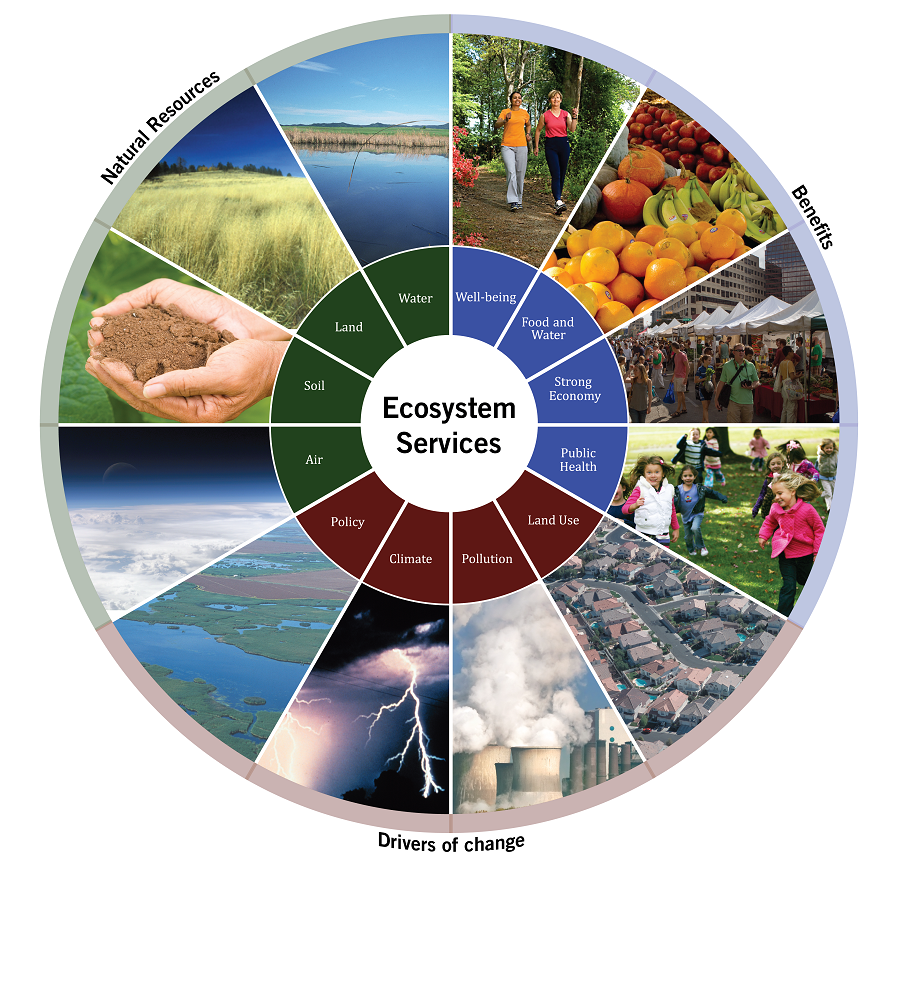
First off, I like the diagram to open up the blog. Has a good balance to it and looks like what we should be concerned about and how we should handle it. We need to take less and hopefully give off(pollute) less making those parts in the diagram smaller.
This whole blog really helps us connect the big picture together which is: we cannot have an economy that does not include the environment. I believe that once we recognize what we are taking from the environment and what we then give it back in return, then we take those factors and slowly shape our ways to reduce them, we will finally have an economic system that has the proper balance with the ecosystem. We need a proper paradigm shift that everyone is going to want to be a part of and not only that, but we will want everything to follow this and we will be able to either take down the monsters at the top (being corporations and the millionaires that don't give two cents about the environment) or changing their selfish, greedy ways.
-- Mike Tierney
I agree with this articles main point about communication. These resources cannot be exploited, and under an Ecosystem Services model, the natural worlds capital would be the basis of all decision making. It is indeed imperative to work for the conservation of ecosystems and habitats, both for what they do for the human species, but also for their intrinsic value. Different communities have different needs, and live amongst different degraded habitats, and thus applying Ecosystem Services will allow for the sustainability of Earth's natural resources amongst any culture. So that environmental services is very appreciate for our future.
Ecosystem Services are very important for both the environment and the people. Most people do not really have much knowledge about the ecological movements we are going under in the recent years and this causes them to behave in a very laxidaxical way towards the environment. This helps them to break free of that and be more aware. Ecosystem services connects the citizens to the environment and help in sustainability of/for the future generations and in turn will help in the economic development too.
The article talks about Ecosystem Services. They are trying to create a society that would integrates the environment in to the economy. This way, people would have a more vested interest in the environment. This way decisions based on the environment aren’t soly made by polliticians and greedy firms. The issue of sustainability and pollution is a coming crisis and it needs to be addressed in a way that affects everyone.
- John D'Onghia
Post a Comment