The following is a summary of a much longer article by Mark Sagoff.
The early 1980s were a period of crisis and change for the environmental movement. President Ronald Reagan had swept to power by campaigning against "environmental extremists" who he said favored "rabbits' holes" and "birds' nests" over jobs and economic growth. In office, Reagan filled his cabinet with anti-environmentalists and subjected environmental regulations to cost-benefit tests.
Greens were challenged intellectually as well as politically. In 1981, a 48 year-old Indian economist named Amartya Sen published a ground-breaking book showing that famines occur not because of failures of production but failures of distribution due to things like poverty, war, and political oppression. Sen's work, for which he eventually won the Nobel Prize, combined with the fact that per capita food consumption rose through the 1970s, discredited the Malthusianism that had been promoted by prominent ecologists such as Stanford University's Paul Ehrlich.
A new scientific case for environmental action was needed, and a new discipline -- ecological economics -- emerged to fill the role. Over the next 30 years, the concepts of ecological collapse, tipping points, and putting a price on nature would fleck the discourse of global political elites in the halls of McKinsey, Davos, and the U.N. Popular figures such as Thomas Friedman, Al Gore, Amory Lovins, Paul Hawken, and Bill McKibben would draw on concepts developed by the ecological economists Herman Daly and Robert Costanza to claim that economic growth undermines the planet's capacity to support human civilization.
In a sweeping new history of the era written for the Breakthrough Journal, the esteemed environmental philosopher Mark Sagoff writes:
Greens were challenged intellectually as well as politically. In 1981, a 48 year-old Indian economist named Amartya Sen published a ground-breaking book showing that famines occur not because of failures of production but failures of distribution due to things like poverty, war, and political oppression. Sen's work, for which he eventually won the Nobel Prize, combined with the fact that per capita food consumption rose through the 1970s, discredited the Malthusianism that had been promoted by prominent ecologists such as Stanford University's Paul Ehrlich.
A new scientific case for environmental action was needed, and a new discipline -- ecological economics -- emerged to fill the role. Over the next 30 years, the concepts of ecological collapse, tipping points, and putting a price on nature would fleck the discourse of global political elites in the halls of McKinsey, Davos, and the U.N. Popular figures such as Thomas Friedman, Al Gore, Amory Lovins, Paul Hawken, and Bill McKibben would draw on concepts developed by the ecological economists Herman Daly and Robert Costanza to claim that economic growth undermines the planet's capacity to support human civilization.
In a sweeping new history of the era written for the Breakthrough Journal, the esteemed environmental philosopher Mark Sagoff writes:
Ecological economists distinguished themselves from neo-Malthusian catastrophists by switching the emphasis from resources to systems. The concern was no longer centered on running out of food, minerals, or energy. Instead, ecological economists drew attention to what they identified as ecological thresholds. The problem lay in overloading systems and causing them to collapse.
But outside the limelight, working ecologists were rejecting the idea of nature as closed, rule-bound "systems" existing in varying states of equilibria. "There is no dynamic order, force, or principle of self-organization that makes every hodgepodge a system," writes Sagoff. Species come and go, and the "systems," "progressions," and "equilibria" are mental constructs. Empirically-oriented ecologists returned to the work of scientists like Henry Gleason who in 1917 described "each association of plants and animals as unique, ephemeral, spontaneous, idiosyncratic, extemporaneous, and a law unto itself."
The radical ambitions of ecological economists to subject the economy to the laws of nature diminished greatly. Many joined the prosaic efforts of neoclassical economists to price ecosystem services; Costanza put the total value of the earth's ecosystems at $33 trillion.
"The Rise and Fall of Ecological Economics" is a cautionary tale. "If environmental decisions are fundamentally framed as questions of economic welfare," Sagoff concludes, "public officials and the public itself will opt nearly every time for whatever policy promises more economic growth, more production, and more jobs." In their obsession to model and monetize nature, ecologists and environmentalists lost their way. Says Sagoff, a former Pew Scholar in Conservation and the Environment:
The radical ambitions of ecological economists to subject the economy to the laws of nature diminished greatly. Many joined the prosaic efforts of neoclassical economists to price ecosystem services; Costanza put the total value of the earth's ecosystems at $33 trillion.
"The Rise and Fall of Ecological Economics" is a cautionary tale. "If environmental decisions are fundamentally framed as questions of economic welfare," Sagoff concludes, "public officials and the public itself will opt nearly every time for whatever policy promises more economic growth, more production, and more jobs." In their obsession to model and monetize nature, ecologists and environmentalists lost their way. Says Sagoff, a former Pew Scholar in Conservation and the Environment:
The scientistic and self-referential controversies in which ecological economists engage drain away the moral power that once sustained environmentalism. This moral power may return if environmentalists employ science not to prescribe goals to society but to help society to achieve goals it already has.

18 comments:
It seems that the article is saying that during the Regan administration, environmentalists completely lost sight of what they wished to protect. It looks like environmentalists of the time forgot to protect the environment and instead looked at it like a commodity to evaluate and price it's value to mankind, as man kind wished to grow and expand.
It can only get better from here, where we stop looking at the earth as if it will always be there. It will not and our world with change dramatically in the next few life times if we continue to forget that as of right now we are stuck here on the planet. The planet will heal itself and if we should become extinct, the planet and it's systems will continue.
Beverly Levine
President Reagan obviously had little concern for the “biosphere” and focused more on the American economy. The term “Reaganomics” emerged as a result of his economic policies. His trickle-down economics, however, rely heavily on the good will of those in the corporate level. Scandals that have come to light in recent years have shown us that altruism at the top echelons of the corporate world may not be commonplace. Since Reaganomics ignored sustainable development, it is no surprise that ecological economics now has a louder voice.
It is interesting how economic extremes such as Reagan’s policies eventually bore fruit to a larger ecological economic movement. Furthermore, the Malthusian trap was discredited and shown that improving our distributive systems, and not our production outputs, is the problem. I think that this breakthrough is a key component in ecological economics. We, as a society, must find a balance between economic growth and sustaining our environment. Economic growth should be considered in conjunction with the capacity in which our environment can replenish itself. According to the post, such a viewpoint is considered radical. It makes sense to me, though. If we want to progress indefinitely, we must be considerate of the space in which we want to advance in.
Lastly, I found it amusing that if a price tag is put on the Earth’s ecosystem, which Robert Costanza valued at $33 trillion, policy makers still forego sustainable development and opt for economic growth.
-Takashi Okamoto
It's interesting to see the roll that environmental economists play in the world today. Since it's an emerging science, society doesn't exactly know what to do with them. It's similar to the situation that we have between religion and science, and the people who lie in the middle of the spectrum. Economy and ecology don't seem to have a middle point in society's mind, yet these people strive to bring those two points together every day. While environmentalists themselves can preach about the morality of saving the earth and how we as humans need to conserve and sustain the world we live in, it will be these people, the environmental economists, that will eventually convince the world otherwise.
The terms that we are on right now cause politicians, corporations, and other money-makers to make the decisions, and they are a big part in whether or not change will occur. The sad truth about it is, if these environmental economists cannot begin to change people's minds, to convince them that economy and ecology go hand in hand, the change is going to come a lot slower.
Leanna Molnar
This article exemplifies the issues with the current economic system plaguing the United States today, and the path in how we came to this place. During his presidency Reagan chose to chastise environmentalists and coin them as people who favored "rabbit holes and bird nests," thus in a sense mocking their intelligence for what is important. Clearly, to Reagan, economic growth was first and foremost of importance. The necessity for growth and expansion in the economy has carried on to the present with steadfast persistence. I think that the findings of ecological economists are groundbreaking, and showcase a world in which we can function amongst finite resources. However, it requires an entire population who has adapted to luxury and access to take back their goods and focus on only necessities. For many Americans, this is simply not an option, and that is because our economy fosters greedy consumerism. From not including the natural world in our economic structure, we have deteriorated the land, and also created a population of people who are addicted to material objects. The combination of the two makes for a challenging fight to keep the Earth functioning and thriving. Nature is telling us that we are overusing its resources by natural disasters, loss of species, soil degradation, and atmospheric changes. The more we foster an economy that wishes to ignore these facts, the further the Earth will deteriorate.
Environmentalism, during Reagan's reign, was not an up most importance; that is apparent. What was not apparent was the consequences of not maintaining environmental protection. Although the population grew, the economy needed to accommodate society and society had to grow. At the given time, economic growth with environmental awareness was not as important. Individuals wanted power and desired money. Moving forward later on, we face hardships such as climate change, endangered species, poverty, etc. As a society, we have to find solutions to sustain earth and increase the economy at the same time. Alternate energy sources, innovated organic food production - society has to strip away from what we are accustom to and adopt a new way of living. If we continue the same in the next 10 to 20, maybe less, years; we could face our own extinction. To improve our current state, we must be considerate of the resources we use and the land we take up. There is no other way to solve this problem but develop consideration and a new lifestyle to accommodate our population and earth.
It is unfortunate that in Modern American History the environment has been so readily overlooked in favor of the economy. Examples favoritism during this time period include the construction of the Alaskan pipeline, which promised to reduce foreign oil dependency at the risk of the Alaskan wilderness. Although the environmental movement might have begun around this point, it took a few decades before it was supported by the scientific community and taken seriously by politicians. Today, while there is still progress to be made, environmentalists are making their voices heard in courts and Congress, and it is the economists who are complaining. There are those who argue that if we put regulations on our natural resources, specifically oil, natural gas, coal, water, trees, and soil, we are impeding our own nation. This argument stems from the idea that to produce more goods, export more items, and create more fuel simply makes an economy and a people stronger, but such is not the case. While doing these things may in the near future improve the country they will do just the opposite in the long run, mostly due to outputs of greenhouse gases and pollution and an increase in non-recyclable waste. So the problem we face lies in supporting our economy or our environment- but (other than greed and stubbornness) I don't see why we can't do both. By whose definition of "economic growth" are we referring? Who claims that they only way to better an economy is to create stuff and things and cause climate change? Certainly not mine. What I feel Sagoff failed to mention in this article are solutions. He ignores the possibility of working with the environment and talks only of conflict between the two. Surely an economy can flourish without the "traditional" sense of growth. For example, there are jobs that can be created to benefit the environment. Engineers are needed to make renewable energy sources, like solar and wind, more mainstream. Farmers should be hired again to replace the machines and factories which took their jobs and have become the top food producers in this nation, and urban gardens will need farmers and store managers. Manufactures who can produce completely recyclable products and packaging should be required. My point is that the economy can benefit and grow and succeed while the environment does as well, and to tell people otherwise is to lose a possible supporter for our cause. Creating such a black and white scenario scares off the public, who then retreats back into their same way of life, pretending they heard nothing.
During Reagan’s administration the need to a powerful military nation, an economic monster, to show America as the portrayal of the most advance nation of this earth. That was the only goal, and in order to achieve it everything was acceptable, even if that meant to destroy “rabbits’ holes and bird’s nests”.
Well the idea of progress is not bad, instead that translates to a better life style for the population of a country. Roads that lead to trade, goods and services that provide a comfortable life style, why not. Perhaps (just for the sake of the discussion) back in the 1980s the care for the environment it really wasn’t a big problem, the world’s population was close to 4 billion, resources were still available in some sort of abundance. Perhaps it was possible. Since then, the residents of the world started to embrace progress in such a greedy way, and since more consumerism hit the streets of middle class, more houses were built and more highways paved, more cars to commute. Here in our country we made sure to be the first, and we still are, with one difference. The population of the world has increased passing the 7 billion barrier that means more houses, more roads, and more carbon monoxide emissions.
On Sagoff’s article is mentioned that “economic growth undermines the planet's capacity to support human civilization”, well this is not far from the truth. It does remind me of “Essay on the Principle of Population” by Malthus. Whether one agrees with Malthus’s theory or not there is something that is real, something that our current generation is paying little attention, the resources of our planet are becoming scarce. Someone said “our planet is not dying, we are killing it”.
Nowadays while the progress of a nation is applauded based on GDP measurements, the decrease of natural resources is taken as if a tree lost a leaf during autumn. This seems to be a replay of politics and economics of the Reagans era. Our politicians now speak about economic recovery, job creation, progress and prosperity; but to what extent? Is the Keystone pipeline going to create hundreds of thousands of jobs to alleviate the unemployment rate in America? Or would the Oil rigs and drilling of the coast of Florida pay our war-earned national debt? The answer is no.
The fact of the matter is that our economic future depends on what we are doing today, on our political decisions. We paid little to no regard to contamination around the world as long as we have our new fashionable garment, shiny 0-miles car, and two dollars per gallon gasoline. We are used to consume, and in this process we are depleting the environment and natural resources. Climate change is real, as is deforestation in the Amazon, the pollution of the Oceans, the thick CO2 cloud over Beijing, and extinction of animal species. Yes there are so many efforts to save many species of animals from extinction, but what is to save an animal when its environment is being destroyed.
Do we want to save the planet or we want to convert it into a nature-devastated, steal structured big sphere like in a sci-fi movie all in the name of progress? It is clear that we have a wrong concept of progress.
It is true, our economic depends on production, trade and consumption, but if we add the term “sustainable” to each of those phases, perhaps and only perhaps we give Earth an extra 100 years to live.
Christian Ordonez
Complimenting ecology with economics seems to be where its founders went wrong. In hindsight arguing with other economists that their methods would be more efficient monetarily of now was absurd. It is no wonder why the US and the world continued pursing the strongest economical plans. Not until morality is appealed to will environmental concerns be addressed.
In economics, the best option is always the highest profiting one. It is no secret that artificial alternatives to nature’s services are usually more profitable. That is the reason why these man made facilities are created, because they offer society a higher return. Preserving ecological systems for the sake of financial benefit is not an argument ecological economist’s can make. An argument of health and wellbeing of the environment and society has to be made. Thankfully environmental economics exists which recognizes the economy is not a subset of the ecosystem but is a field that exists to aid our pursuit in what is believed in classical economics while still maintaining the well being of the world. Being conditional and instead looking for environmentally friendly alternatives to current practices is more beneficial to society as a whole.
Reagan's presidency definitely stands out among the rest due to the injustice faced by environmentalists and the natural world during this time. His blatant disregard for and refusal to acknowledge the importance of the environment resulted in much more environmental degradation than ever should have been allowed during this time. This is an issue that our country continues to face: those valuing economic growth over equal distribution of wealth and goods and environmental protection. this article makes it painstakingly clear that by continuing to ignore the limitations our environment places upon us we are leading to our own demise. Economists must stop this either-or view and accept the fact that in order to grow and develop sustainably, growth must not be the only goal in sight.
-Haylei P.
Ecological economics is a trans-disciplinary field. It is not a sub-discipline of economics or ecology.It looks at the overall ecosystem that people live in and interact with. Whereas Environmental Economics is a sub-discipline that studies economics taking the environment into consideration.Adding principles of economics, while talking about ecology seems wrong since economics in general treats the environment as a side factor and focuses more on markets and growth.It is much more useful to research how to eliminate negative externalities, such as pollution, rather than trying to tie ecology with contradicting rules of economics.
Environmental economics drives the creation of alternative resources that will prevent the exhaustion of natural ones. On the other hand, while that's happening many countries suffer because their whole economy is based on exporting their natural resources. For example, what is now happening in the oil market with the shale oil revolution . This will be a much cheaper and more sustainable alternative to conventional oil but at the same time it will harm the economies of the big oil producers. Therefore, this choice to be eco-friendly or green also has consequences on peoples lives in the short-run.
However, in the long-run, when economies completely switch to alternative sources of energy and raw material it will be extremely beneficial to the environment.
Annie Stishov
Former President Reagan set a precedent that pushed the efforts of environmentalism to the back burner. Not only did he weaken environmental laws, he showed the nation just how much he valued the environment by having the solar panels on the White House rooftop removed. His message was clear: economic growth takes priority over the environment in which it is embedded. Reagan saw the economy and the environment as two separate entities having no connection whatsoever. Today, more people are seeing the connection and are realizing that in order to sustain ourselves we must sustain the environment. Ecological economics is start which has the potential to make an impact. However, in order to truly sustain ourselves we would need to construct a radically different structure of society. Until then, we need to implement and enforce pro-environmental policies as well as come up with new, creative, and eco-friendly business practices.
-Emma Weis
THis article really highlights some of the serious problems that environmentalists faced during the Reagan administration. By outcasting these environmentalist the Reagan Administration showed what government was all about, the economy. It was interesting to see how the article values the environment at 33 trillion dollars, i would think the value would be endless/infinite as without the environmental everything would collapse and fail. As someone said in an earlier post i am also very interested to see what happens with Env Econ in the future as there is room for so much good to happen.
Nick Stanton
This article conveys the view towards environmentalism during the early 1980's. Environmentalists were seen as favoring "bird's nests." This lead towards a view of increasing growth without respect to the environment. Fortunately ecological economists were able to distinguish their view towards growth and economics. Eventually their view was not popular due to the public opinion towards capitalism and growth. As environmental degradation increases, hopefully more of the public will start to put prices on the pollution associated with growth.
-Frazer Winsted
It almost seems like during President Regan's administration, he mostly cared about the monetary economic growth of the country as opposed to what effects they would probably have on the environment. What environmental economics have stood for since the end of the Regan's term has been astounding and they have shed a lot of light on how ignorance has played a part in the negligence on the environment.
This article mainly claims that ecological economics started promisingly but got sidetracked by adopting environmental valuation and cost-benefit analysis and is now ignored by everyone. Sagoff has been a consistent opponent of cost-benefit analysis. I think the essay is very polemical and overemphasizes some trends while ignoring others. Some ecological economists have adopted mainstream approaches to non-market valuation of the environment for largely pragmatic reasons as described. There has been convergence between ecological and mainstream environmental economics over time, but it hasn't been a one-way street. Personally, I have always been opposed to non-market environmental valuation for both practical and philosophical reasons. I don't believe that it is possible to come up with at all credible prices through these approaches and especially not sustainability-relevant prices. I am all for efficiency though in implementing goals once society has decided on them.
-Derek Fields
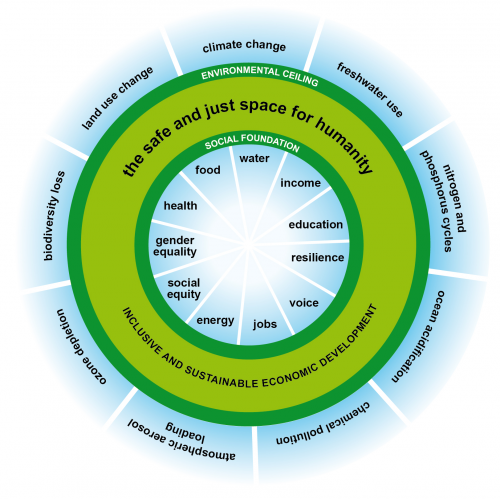
The article opens talking about the Regan administration which I was aware did many good things but was not aware that they actually were non environmentalists that wanted more jobs, etc. The model that is shown really gives a decent view of how we should mentally implement the environment into. The cap is surpassed and we get things like climate change, problems with our ocean currents, pollution problems, environmental degradation, the whole nine. However, it does not recognize how we deal with these problems mainly because the problems have not been dealt with successfully.
Most people will back anything that will give them more money, more jobs, and more success in the near future disregarding anything that could happen in the further future. we need to stop thinking about ourselves with these selfish actions. everyone is simply out to better themselves as if we are primates in the wild living the "survival of the fittest," when really it is not the fittest its the most manipulative, and the key to manipulation is money. I don't think any economist will take into proper consideration the effects on the world and the environment unless they can make big money off of it. Really! and unfortunately plants and animals don't have money or valuable stocks to trade in order for them to keep the trees they live in and the waters they drink from clean. But it isn't just the animals that will be affected and we need to realize this more. This is our world, and we are the strongest force in our world. We degrade the environment the worst, so why can't we clean it up and stop the degradation when we are the strongest ones? I think this is because we have replaced ourselves at the top of the power pyramid. People are not the most powerful force on the Earth, money is $$$! We need to reclaim our power away from money and restore our environment.
--Michael Tierney
The article begins with a discussion of the 1980's in which the belief's that President Reagan bring's to the limelight. Reagan truly tried to jolt the economy and spur growth. However, as Mr. Sagoff believes, he was truly against environmentalist's and attempted to lessen environmental regulation.
In 1981, a groundbreaking book published by economist Amartya Sen which showed that "famines occur not because of failures of production but failures of distribution due to things like poverty, war, and political oppression." Her work would enable her to win a Nobel Prize.
Now over the next 30 yr's, similar concepts of "ecological collapse, topping points, and a price on nature would fleck the discourse of global political elites in the hall's of McKinley, Davos, and the U.N."
Additional other's would draw on previous concepts that were developed by Robert Costanza and Herman Daly which "claimed that economic growth undermines the planet's capacity to support human civilization."
To conclude, the article Sagoff states that "if environmental decisions are fundamentally framed as questions of economic welfare then public officials and the public itself will opt for nearly every time for whatever policy promises more economic growth, more production, and more jobs."
Personally, I believe that both sides raise important issues however, I feel that in order to move forward both sides must consolidate. Society is already structured in a way that moves toward's growth and technological advancement however, in order to achieve a sustainable future, we must make an effort to both protect the environment and grow.
-- Dylan Troy
In the article its obviously stated that President Regean’s administration, as well as environmentalists, lost sight of the future for the biosphere. They were more concerned with the economy, than anything else. Hence the term “Reaganomics”. In recent years, ecological economics has more of a voice, due to in part that the Regan administration has been over for decades, and we are not feeling the backlash of it. We have to find a happy medium between economic growth, and environemetal sustainability. Something that the Reagan administration lacked.
-John D'Onghia
Post a Comment