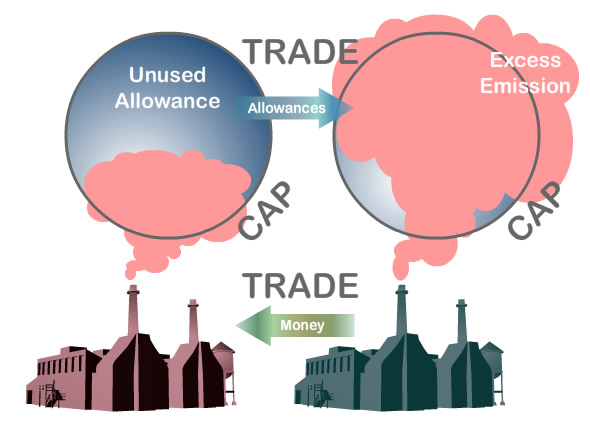
An argument in favour of carbon taxes over cap & trade is that cap & trade requires an efficient secondary market. As we know from recent experience, financial market efficiency cannot be taken for granted. While the instrument that is traded in the secondary market under cap & trade is relatively simple, compared to Residential Mortgage-Backed Securities based on US subprime mortgages, cap & trade does have this additional link in the chain, and is therefore vulnerable to all the familiar financial market pathologies, from market manipulation to illiquidity.
The economic equivalence of carbon taxes and cap & trade is exact only in a world without uncertainty, or in a world with uncertainty but with complete contingent claims markets for risk trading. In the real world, where there is uncertainty and markets are incomplete ….
Why then do politicians and outfits like BP prefer cap & trade to a carbon tax? The politicians prefer it because the cap & trade scheme, while economically equivalent to a tax, will not count as a tax in the traditional record-keeping manuals. It does not add to the official 'tax burden' the opposition likes to bash you around the head with. You can present cap & trade in a way that hides/obscures the fact that for it to work, that is, for it to reduce emissions, it must be equivalent to a tax by increasing the marginal cost of emitting CO2E; however, it does not look like a tax and will not show up in conventional tax burden calculations. Lack of transparency means absence of accountability. That is why non-transparent arrangements are universally valued by politicians.
A second reason is that with cap & trade, you can distribute the shadow tax revenue associated with the cap & trade scheme (that is the amount of revenue you would be able to obtain for the permits in a transparent, competitive auction) in a non-transparent manner. Give-aways through explicit grants or subsidies are not as easy. There are parliamentary committees scrutinizing revenues and outlays; there may be institutions like the UK National Audit Office that can ask bothersome questions.
Life is easier with the initial allocation of permits. You can, for instance, hand out the permits free of charge to your friends (including the heavy historical polluters). This is also the reason, I believe, that the heavy emitters, including BP, favour cap & trade over taxes. They believe that the initial allocation of free permits will favour them. There is this crazy notion that past heavy polluters should not be hit too hard by schemes to reduce CO2E emissions, and that they should therefore be given gratis allowances of permits that are related to their recent past emissions record. I can see no efficiency reason in favour of this, and many a fairness argument against it, but the argument carries weight in the unreal real world.
When the problems associated with running an efficient secondary market for CO2E emissions permits and the political economy of the non-transparent initial allocation of the CO2E emissions permits are taken into account, I believe that, on balance, explicit carbon taxes are better than cap & trade.

13 comments:
To begin, let us first define cap and trade. To begin, Cap and Trade is "a regulatory system that is meant to reduce certain kinds of emissions and pollution and to provide companies with a profit incentive to reduce their pollution levels faster than their peers. Under a cap-and-trade program, a limit (or 'cap') on certain types of emissions or pollutions is set, and companies are permitted to sell (or 'trade') the unused portion of their limits to other companies that are struggling to comply." In this case, the government essentially creates an artificial secondary market in which companies can trade "credit's" giving them the right to pollute a particular amount. This has been used to mitigate cases of sulfur dioxide or acid rain. As the article states, several large corporations as well as some politicians favor cap and trade versus a carbon tax.his has been used in the case of sulfur dioxide or "The politicians prefer it because the cap & trade scheme, while economically equivalent to a tax, will not count as a tax in the traditional record-keeping manuals. It does not add to the official 'tax burden' the opposition likes to bash you around the head with. You can present cap & trade in a way that hides/obscures the fact that for it to work, that is, for it to reduce emissions, it must be equivalent to a tax by increasing the marginal cost of emitting CO2E; however, it does not look like a tax and will not show up in conventional tax burden calculations. Lack of transparency means absence of accountability. That is why non-transparent arrangements are universally valued by politicians." The Obama Administration is very supportive of the cap and trade system. Additionally, for many, life is simply easier with the "initial allocation of permits." The article discusses why companies favor this. "You can, for instance, hand out the permits free of charge to your friends (including the heavy historical polluters). This is also the reason, I believe, that the heavy emitters, including BP, favour cap & trade over taxes. They believe that the initial allocation of free permits will favour them." However, the major concern of the cap and trade system is the need for an efficient secondary market. As the author states, "when the problems associated with running an efficient secondary market for CO2E emissions permits and the political economy of the non-transparent initial allocation of the CO2E emissions permits are taken into account, I believe that, on balance, explicit carbon taxes are better than cap & trade." Although a carbon tax is a better process, unfortunately they're are some pretty substantial barrier's that we must break down in order to create a more efficient process.
-Dylan Troy
To be honest, I'm having a tough time understanding the economics of all of the material we are discussing, but I think I have a decent idea of what cap and trade and carbon tax mean. As to which is better, I'm not sure. The answer to that question would probably depend on several variables that I am far too uneducated in economics to understand.
While I quite like the idea of a carbon tax as an incentive to stop polluters, I think it makes sense that politicians and companies who are polluting would prefer the cap and trade program. The only real issue I have with cap and trade is that I feel it lets polluters off too easily. It's good that a line is being drawn at how much carbon is allowed to be emitted, but it's bad that a corporation that is polluting too much could be given permission to pollute even more by buying this option from other groups. Sure, this heavy-polluter has to go through some hassle to make their emissions legal, but in theory this can be (and is) done. I think that this will create a counter-productive mindset and culture opposite to the one us environmentalists wish to see. The carbon tax, at least, is a very distinct "no." It alerts everyone who pollutes that their pollution is not wanted and they must pay money to allow it. Saving money here is a very simple incentive that can easily be understood. And if there is one thing business like doing, it's saving money.
This debate of cap and trade versus carbon tax has many sides, all of which have good points and arguments to be made. I'm curious, and a little afraid, to see what the governments of today and tomorrow will favor. Of course, the best solution is to eliminate pollution all-together, but I suppose that's not quite as realistic as these other two options.
The issue of cap and trade versus carbon taxes brings up issues of market manipulation, as this post indicates. In the lens of cap and trade, this manipulation is tenfold. On the surface, it seems like a positive method towards decreasing emissions, creating a system of "capping off" at a level of pollution and trading the remainder to struggling companies. The "cap" of this system is indeed worth appreciation, in the sense that companies are noting when there emissions are reaching a level of danger or concern. However, judging from current trends, and examples of polluting intensive companies such as BP or Shell, it is hard to determine if even the "cap" system is working. Nevertheless, the "trade" portion is where the lines of transparency begin to greatly dim. As the post indicated, cap & trade methods do not look like taxes and are therefore not treated as one. Loopholes in the system follow. "You can present cap & trade in a way that hides/obscures the fact that for it to work, that is, for it to reduce emissions, it must be equivalent to a tax by increasing the marginal cost of emitting CO2E; however, it does not look like a tax and will not show up in conventional tax burden calculations. Lack of transparency means absence of accountability." Thus, without accountability, companies can use cap & trade to their advantage, claiming they are helping the environment, but really just using this system to forward ulterior motives - whatever they may be. With carbon taxes however, fossil fuel prices would rise, with an emphasis on the need for divestment. With a raise in fossil fuel prices consumers would finally see the costs of externalities such as possible environmental consequences. Transparency, in this case, is clear & noted. Thus, I agree with this post that carbon taxing seems like the better choice than cap & trade.
On the surface, cap and trade seems like the obvious solution--it gives companies incentive to pollute less, so that they can make money off of others that cannot, or will not, reduce their emissions. However, as this article explains, there are many problems with this supposed policy change, things that are great in idea form, but not so great in actual policy form. The way that cap and trade is set up (at least what I get from this article) is that it is harder to track cap and trade numbers than it is to track taxes within companies. Cap and trade requires companies to report the amount of their emissions, instead of reporting that their emitting at all. This allows for a degree of uncertainty looking upon a company. Are they telling the accurate calculations? Most likely their probably not. With a tax, they would get taxed either way. But with cap and trade, accurate numbers are very important in determining how much they will pay, which is in turn an incentive to lie about how much they give off in order to have a gain in the market while still looking environmentally friendly. For these reasons, cap and trade needs to be seriously reconstructed, or we need to stick to taxes.
Leanna Molnar
After reading the article, it seems as though cap and trade are not effective at limiting carbon emissions. This is mostly due to the allocation of permits allowing some companies to be heavy polluters by paying a small price to buy permits from non polluting companies. In essence this is slightly similar to a carbon tax. The exception is that a carbon tax can increase in price if the country is not seeing the improvement that it desires. Carbon taxes do not give money to good companies, but they hold all companies accountable; therefore the likely outcome would be a heavy decrease in pollution except from companies that can afford the taxes. Big business does not favor the carbon taxes because the business would have to pay huge costs in upgrading current infrastructure in order to meet the new standards. In my opinion, carbon taxes are the way to go as they will set the example for the rest of the world on carbon emission standards.
-Frazer Winsted
Cap and trade is one of the main forms of emission trading. Under the schemes of cap and trade, the governments and/or intergovernmental bodies set an overall legal limit on greenhouse gas emissions in a certain time period, and then grants industries a certain number of licenses to pollute. Companies that do not meet their cap can buy permits from others that have a surplus (or a trade). This is supposed to provide a cheap and efficient means to limit greenhouse gas reductions within a tightening cap. In practice, it has rewarded major polluters within windfall profits, while undermining efforts to reduce pollution and achieve a more equitable and sustainable economy.
Some problems with cap and trade: the cap has too many holes and sometimes doesn’t “cap” anything at all. The cap is only as tight as the least stringent part of the system. This is because those with a surplus sell permits, and the cheapest way to produce a surplus is to be given too many permits in the first place. Another problem, the “trade’ component does not require any emission reductions. It simply allows companies to buy cheaper “emission allowance” or “carbon offsets” which are supposed to represent emissions reductions elsewhere.
In chasing after the cheapest short-term cuts, cap and trade tends to encourage quick fixes to patch up outmoded power stations and factories, delaying more fundamental changes. What is cheap in the short-term does not translate to an environmentally effective or socially just outcome over the long-term.
Having no real prior knowledge of cap & trade systems, it seems as if it is overall, ineffective. Especially the "lack off transparency" systems which are very deceitful. As we have learned there cannot be actions without consequences. Someone always has to pay whether its the company itself or the public. Polluting companies should be held responsible for their actions and politicians should not endorse taking advantage of the constituents.
-Emma Weis
Yes, I also agree with writer “ on balance, explicit carbon taxes are better than cap & trade”. Environment New Jersey and found that formal action was required under the state Administrative Procedure Act. The NRDC and Environment New Jersey had sued the state in June 2012, claiming it should have allowed the public to weigh in.
The carbon dioxide trading regulations were supposed to enable New Jersey's participation in the regional greenhouse gas program but were “sufficiently broadly worded to allow for implementation of a program independent of RGGI,” the unpublished opinion said.
“In addition to the department posting information on its website apprising the regulated community of the ramifications of the state's withdrawal from RGGI, the department should have taken action to repeal the regulations or amend them to clarify that they do not create a stand-alone trading program,” the opinion said. “Indeed, had the department done so when the issue was first raised by Environment New Jersey and the council, this appeal would have been unnecessary?
The cap and trade system seems like another scheme to “commodify” our planet and its finite resources, giving corporations an avenue to continue business as usual under the guise of "capping" or off setting carbon emissions. A carbon tax would be much more effective as it comes like a sin tax, tacking on additional fees for an undesirable/harmful behavior. In this way, the goal is to incentivize those polluters to move away from environmentally harmful activity (i.e. carbon emissions) and into the realm of environmental stewardship. A cap and trade system is not punishing polluters and that must be done. A carbon tax however, is the way to go as it will most certainly ensure that companies recognize their failures, calling for a complete reassessment of business models, policies and practices. In the future, I most certainly hope taxes like these will begin to account for all environmentally irresponsible behavior and not just emitting carbon. Ex: If a business manufactures electronics then it most likely sources its raw material from a mine pit which may have been agriculturally productive or heavily forested…… either way, the damage has been done. While carbon taxes are great for controlling what comes out of the factory, much more focus needs to be given to the sourcing of raw materials where entire ecosystems are ravaged daily for manufacturing. A system could be conceptualized and implemented where taxes are handed down to those companies whose production and manufacturing directly inhibits productive ecosystem, especially those that are “virgin”, furthering destroying pockets of critical ecosystem that remains.
I am not familiar with Cap & Trade, and this is really the first time reading about such a concept. Maybe that's the way oil companies prefer. But it seems like to me that it's a preferable alternative to a formal tax, so that big polluting companies can pass on all their expenses to their consumers. The internet and advancing technology is making everything more transparent, and people want it that way. Transparency is a good thing if you aren't doing anything wrong, but feared by those who have something to hide. 100% is not possible, but certainly big corporations need a greater deal of transparency.
I am happy I was involved in the mock trial this semester, and I learned a thing or two about cap and trade. Basically there's a certain cap of emissions that regulates the amount of pollution that is given off by a particular kind of institution. When a cap is reached, they cannot pollute anymore. However, if another place does not reach the cap, they sell the remaining availability of pollution to them in order for them to be up to code. It really makes sense when you look at the numbers, but coming from an environmental aspect it is not fair. Like I mentioned in my other post, we need to be saving as much as we possibly can and we should not be able to sell room in the air for anything. I thought we couldn't put a value on the environment?
-Mike Tierney
This is the first I’ve read about Cap & Trade. As someone else mentioned it seems like the oil companies are using it as a tax. This way their expenses are being passed on to their consumers. Another point is that when certain companies reach their pollution cap, they can just buy the remaining balance of another company. Therefor pollution is being minimized, its just being transferred from one company to the next. The environment is priceless and we should be regulating it more. Not allowing the pollution to just be passed on to the next firm. Now that we have all this technology and more people have the capability of seeing what firms do with their waste. - John D'Onghia
There's much debate about the efficacy of controlling pollutants with economic incentives, also known as cap-and-trade. Its advocates dress it up with a lot of moral indignation. Cap-and-trade would not achieve its goals and it would put America on a ruinous course. Cap-and-trade would raise prices for the energy we get from natural gas, coal, and oil. Putting a tax on carbon means that every American who flips a light switch, turns a car key, or buys anything made or shipped in this country will pay more. The Treasury Department estimates that the president's cap-and-trade approach would "generate federal receipts on the order of $100 billion to $200 billion annually"; the Congressional Budget Office (CBO) reports that a 15 percent CO2 reduction would cost an average household $1,600 a year. Other experts say the price tag could be much higher. That would mean utility bills will rise everywhere, exploding in some parts of the country.
Derek Fields
Post a Comment